
LASIK vs. SMILE Surgery: Comparing Vision Correction Techniques
Compare LASIK vs SMILE surgery for vision correction. Learn the differences, benefits, risks, recovery time, and success rates to choose the best laser eye surgery for your needs.

Medically Reviewed By:
Dr Advaith Sai Alampur
Leading LASIK & Refractive Surgery Expert
Condition:
Myopia
(Near sightedness)
Treatment:
LASIK
(Laser Eye Surgery)

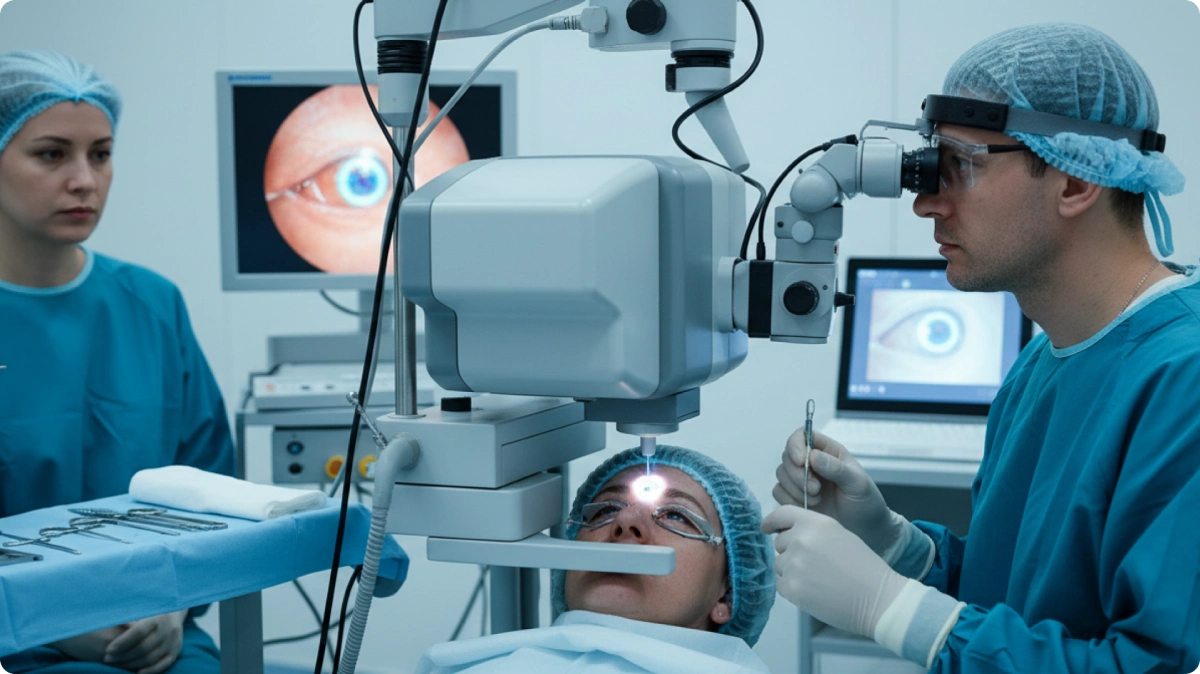
When it comes to vision correction, LASIK (Laser-Assisted in Situ Keratomileusis) and SMILE (Small Incision Lenticule Extraction) emerge as the two most popular procedures.
Each one provides some fantastic visual improvement and frees you of the need for glasses or contacts.
Knowing what the pros, cons and patient results of each can be a great tool should you decide to go down that road.
In this article
- LASIK reshapes the cornea to correct nearsightedness, farsightedness, and astigmatism.
- The procedure is FDA-approved, safe, and uses modern laser technology for precision.
- Candidates should be over 18, have a stable prescription, and healthy corneas.
- Short-term side effects can include dry eyes, halos, glare, or temporary vision fluctuations.
- Most patients achieve stable, long-term vision improvement and are satisfied with results.
- LASIK doesn’t stop natural age-related changes, so reading glasses may still be needed later.
Understanding LASIK and SMILE
⇒LASIK Surgery
LASIK – Laser in-situ keratomileusis LASIK is a well-known laser eye surgery technique that creates a thin flap in the cornea with either a microkeratome blade or a femtosecond laser.
After that, an excimer laser reshapes the cornea to correct refractive errors like myopia, hyperopia and astigmatism.
⇒SMILE Surgery
What is a SMILE?SMILE was developed relatively recently and is far less invasive than LASIK.
This is done by creating a small disc of tissue in the cornea (lenticular) with a femtosecond laser, which is then extracted through a tiny incision.
It alters the shape of your cornea to correct myopia and, less commonly astigmatism.




(Put Real times images and shorts of Dr Avdaith Sai Consulting, Operating on Patients)

Watch Patient Journeys

Visit Our Centre
Benefits of LASIK
1.Proven Track Record: LASIK has been performed for over two decades, with millions of successful cases worldwide.
2.Wide Range of Corrections: Effective for myopia, hyperopia, and astigmatism.
3.Quick Recovery: Most patients achieve improved vision within 24 hours.
4.Enhanced Precision: Advanced wavefront technology offers highly customized corrections.
Are You the Right Candidate for LASIK?
Fill the form & we will tell you if LASIK is right for you. Its Free!
Benefits of SMILE
1.Minimally Invasive: Requires a smaller incision (2-4 mm), preserving corneal integrity.
2.Reduced Dry Eye Risk: Less disruption of corneal nerves, leading to fewer dry eye symptoms post-surgery.
3.Fast Recovery: Comparable to LASIK, with many patients resuming normal activities within a day.
4.Less Flap Complications: Eliminates the risk of flap-related issues since no flap is created.
Risks and Complications
⇒LASIK
1.Flap Complications: Risk of flap dislocation or wrinkling.
2.Dry Eye Syndrome: Higher incidence due to nerve disruption.
3.Halo and Glare: Some patients report night vision disturbances.
⇒SMILE
1.Limited Corrections: Primarily for myopia and minor astigmatism, not suitable for hyperopia.
2.Newer Technique: Less long-term data compared to LASIK.
3.Accuracy: Some studies suggest slightly less precision in higher-order aberrations compared to LASIK.
Patient Outcomes
1.LASIK Outcomes
Patients typically experience rapid visual improvement, with 96% achieving 20/20 vision or better. The procedure is highly customizable, leading to precise corrections and high patient satisfaction.
2.SMILE Outcomes
Studies indicate that SMILE patients also achieve excellent vision, with over 85% reaching 20/20 vision or better. The reduced incidence of dry eye and flap complications makes it an attractive option for eligible candidates.
Conclusion
Both LASIK and SMILE offer significant benefits for vision correction.
LASIK is a versatile, well-established procedure suitable for various refractive errors, while SMILE provides a minimally invasive option with fewer complications.
Consulting with an experienced ophthalmologist will help determine the best approach for your unique vision needs.
LASIK for Pilots in India: A Guide to Vision Standards & Safety
LASIK for pilots in India: DGCA rules, Armed Forces standard…
AI in LASIK Surgery: How Artificial Intelligence Is Transforming Vision Correction (2026)
SMILE Pro preserves 80% more corneal nerves than LASIK by us…
Environmental Factors and LASIK Outcomes: How Pollution and UV Exposure Influence Success and Longevity
Learn how pollution and UV exposure affect LASIK outcomes, h…