
How Artificial Intelligence Helps in Ophthalmic Surgery?
Have you ever wondered how eye surgeries have become so precise and safe in recent years? The secret is Artificial Intelligence (AI).
Medically Reviewed By:
Dr Advaith Sai Alampur
Leading LASIK & Refractive Surgery Expert
Condition:
Treatment:

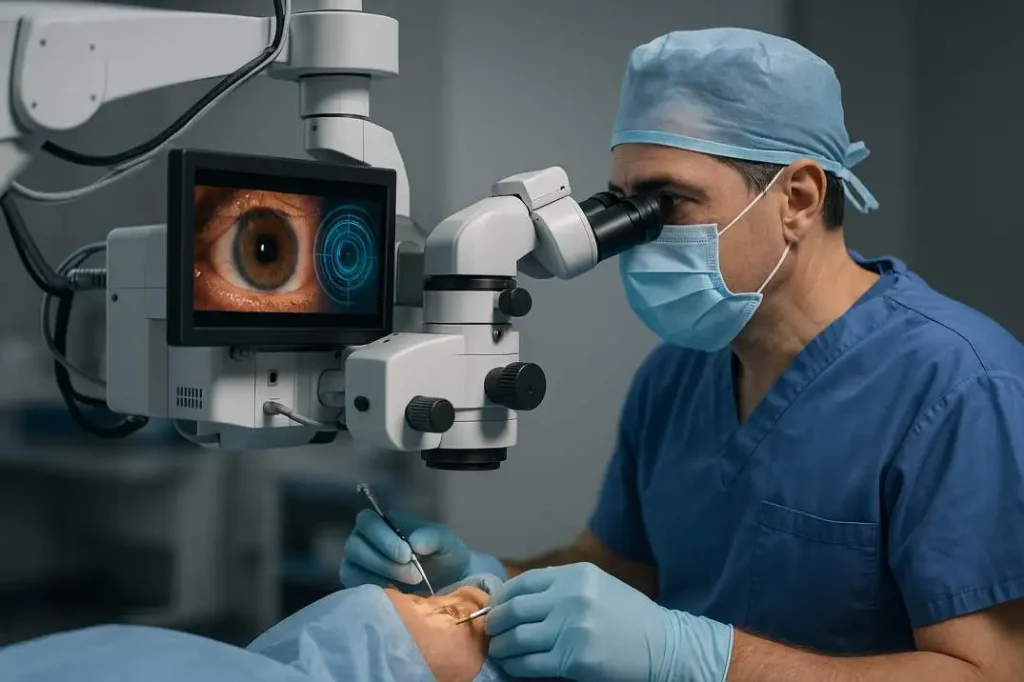
In this blog, I will walk you through exactly how AI is changing ophthalmic surgery, making procedures faster, more accurate, and safer than ever before. And yes, I’ll share some of my personal experiences as a doctor who has seen AI’s magic unfold in the operation theatre.
In this article
- LASIK reshapes the cornea to correct nearsightedness, farsightedness, and astigmatism.
- The procedure is FDA-approved, safe, and uses modern laser technology for precision.
- Candidates should be over 18, have a stable prescription, and healthy corneas.
- Short-term side effects can include dry eyes, halos, glare, or temporary vision fluctuations.
- Most patients achieve stable, long-term vision improvement and are satisfied with results.
- LASIK doesn’t stop natural age-related changes, so reading glasses may still be needed later.
What Is Artificial Intelligence (AI) in Simple Words?
Before we dive deeper, let me explain AI in simple language.
AI means machines or software that can think, learn, and make decisions just like a human would.
In ophthalmology (the science of eye care), AI helps doctors by:
Analyzing eye scans and reports faster than a human can
Guiding surgical instruments during operations
Predicting possible complications
Helping in early diagnosis of eye diseases




(Put Real times images and shorts of Dr Avdaith Sai Consulting, Operating on Patients)

Watch Patient Journeys

Visit Our Centre
Why AI Is a Game-Changer in Ophthalmic Surgery?
Let’s break down how AI helps at every stage of eye surgery:
AI for Pre-Surgical Diagnosis and Planning
AI analyzes diagnostic scans such as OCT (Optical Coherence Tomography), fundus photographs, and corneal topography reports.
How does it help?
Detects conditions like glaucoma, diabetic retinopathy, macular degeneration early
Suggests the best surgical plan tailored to the patient
Reduces human error in diagnosis
As an eye doctor, I’ve seen AI detect tiny retinal changes that I could barely notice with my own eyes. This early detection can prevent blindness.
AI in Refractive and Cataract Surgeries
AI plays a major role in:
LASIK and SMILE surgeries for removing glasses
Cataract surgeries where the cloudy lens is replaced
How exactly does AI help?
Maps the cornea with extreme accuracy
Chooses the perfect intraocular lens (IOL) power
Guides laser positioning in real time
in my practice, I have seen patients achieve 6/6 vision post-surgery because AI helped select the perfect lens power and alignment.
AI for Surgical Navigation
During surgery, AI acts like an intelligent assistant:
It guides instruments based on 3D maps of the eye
Adjusts for micro-movements of the eye
Reduces the chance of surgical errors
AI in Robotic-Assisted Eye Surgeries
Yes, robots powered by AI are now assisting eye surgeons.
They provide stability beyond human hands
Perform micro-movements during delicate surgeries
Reduce surgeon fatigue and increase precision
AI for Post-Operative Monitoring
AI doesn’t stop at surgery. It helps in:
Monitoring healing through image analysis
Predicting complications like infection or swelling
Advising follow-up care plans
Are You the Right Candidate for LASIK?
Fill the form & we will tell you if LASIK is right for you. Its Free!
Examples of AI Tools in Ophthalmic Surgery
Here are some popular AI tools and technologies I use or see in modern eye surgeries:
|
AI Tool |
Use Case |
|
VERION™ Image Guided System |
Maps eye structures for cataract surgery |
|
Catalys™ Precision Laser System |
AI-driven femtosecond laser for cataract |
|
Navilas® Laser System |
AI-guided retinal laser treatments |
|
DeepMind’s AI |
Predicts eye disease progression from scans |
|
Alcon ORA System |
Intraoperative IOL power adjustment |
Is AI Replacing Eye Surgeons?
Absolutely not. AI is like a super-smart assistant that helps the surgeon. The surgeon still makes the final decisions.
In my experience, AI gives me more confidence during surgery, but my skills and decisions are still the key to a successful outcome.
Benefits of AI in Ophthalmic Surgery (For Patients)
- Safer surgeries with fewer complications
- Faster recovery time
- More accurate vision correction
- Early detection of eye diseases
- Personalized treatment plans
Common Questions Patients Ask Me About AI in Eye Surgery
Q: Is AI eye surgery more expensive?
A: It can be slightly costlier due to advanced technology, but most patients find the extra cost worth it for the added safety and precision.
Q: Will AI surgery hurt more?
A: No! In fact, AI helps make the surgery smoother and gentler.
Q: Can AI predict if my surgery will be successful?
A: Yes. AI analyzes many factors and gives a high success probability, but remember, no system can guarantee 100%.
Limitations of AI in Ophthalmic Surgery
While AI is powerful, it has limits:
It depends on the quality of input data (bad scans = wrong AI guidance)
AI can’t handle unpredictable situations on its own (the surgeon must intervene)
It requires high-quality, costly equipment
As a surgeon, I always cross-check AI recommendations with my clinical judgment.
Future of AI in Eye Surgery
Imagine AI systems that:
Can perform parts of surgery automatically🚀
Can spot diseases years before symptoms🚀
Can guide surgeons through VR headsets🚀
💬I believe the future of eye care will be a beautiful teamwork of human skills and AI intelligence.
Final Thoughts
👉Yes! AI in eye surgery is like having an expert co-pilot. It makes surgeries safer, faster, and more precise. But always choose an experienced surgeon who knows how to use AI tools well.
💬From my personal experience, I can say AI has made my surgeries better and my patients happier. It is a blessing in modern eye care.
Key Takaways
|
Point |
Summary |
|
What is AI in eye surgery? |
AI helps in diagnosis, planning, guiding, and monitoring eye surgeries |
|
Main benefits |
Precision, safety, faster recovery, fewer complications |
|
Surgeon’s role |
AI assists, but the surgeon leads |
|
Should you consider AI-assisted surgery? |
Yes, it offers better outcomes |
LASIK for Pilots in India: A Guide to Vision Standards & Safety
LASIK for pilots in India: DGCA rules, Armed Forces standard…
AI in LASIK Surgery: How Artificial Intelligence Is Transforming Vision Correction (2026)
SMILE Pro preserves 80% more corneal nerves than LASIK by us…
Environmental Factors and LASIK Outcomes: How Pollution and UV Exposure Influence Success and Longevity
Learn how pollution and UV exposure affect LASIK outcomes, h…