
What Can ICL Eye Surgery Be Used to Treat?
Imagine waking up, seeing the world clearly without the burden of glasses or contact lenses. For many, this dream has become reality thanks to ICL (Implantable Collamer Lens) eye surgery.

Medically Reviewed By:
Dr Advaith Sai Alampur
Leading LASIK & Refractive Surgery Expert
Condition:
Treatment:


Whether you’re tired of dealing with glasses slipping down your nose or struggling with the dryness that contact lenses cause, ICL surgery might be the life-changing solution you’re looking for.
But what exactly is ICL surgery, and what eye conditions can it treat? Stick with me as I walk you through everything you need to know – from the basics to the benefits, risks, and even tips to help you decide if it’s right for you.
In this article
- LASIK reshapes the cornea to correct nearsightedness, farsightedness, and astigmatism.
- The procedure is FDA-approved, safe, and uses modern laser technology for precision.
- Candidates should be over 18, have a stable prescription, and healthy corneas.
- Short-term side effects can include dry eyes, halos, glare, or temporary vision fluctuations.
- Most patients achieve stable, long-term vision improvement and are satisfied with results.
- LASIK doesn’t stop natural age-related changes, so reading glasses may still be needed later.
What Is ICL Eye Surgery?
Before we get into the ‘what it treats,’ let’s break down what ICL surgery really is. This procedure involves inserting a thin, artificial lens made of a biocompatible material called collamer into your eye, positioned just behind the iris. Think of it like contact lenses – but instead of popping them in and out every day, they’re permanently implanted!
The beauty of ICL surgery is that it’s additive and reversible. Unlike laser treatments like LASIK, no corneal tissues are removed. If needed, the lenses can be removed or replaced at any time. Plus, it’s practically invisible – no one will know you’ve had it unless you tell them.
Okay, now for the big question…




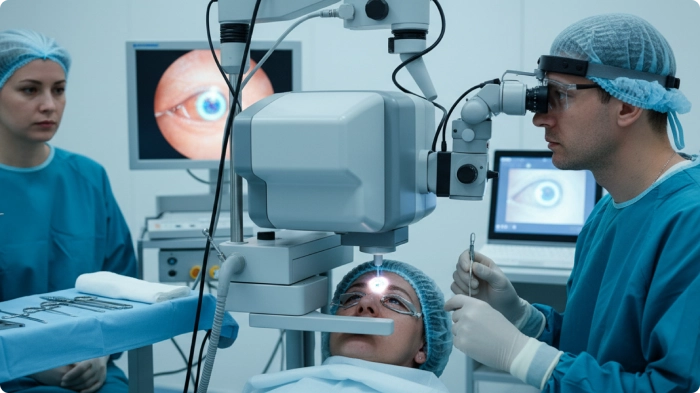
(Put Real times images and shorts of Dr Avdaith Sai Consulting, Operating on Patients)

Watch Patient Journeys

Visit Our Centre
1. Severe Myopia (Nearsightedness)
Do distant objects look blurry while you can see things up close just fine? If you have myopia, you’ve probably experienced this. ICL surgery is primarily used to treat severe nearsightedness – usually when glasses or traditional laser eye surgery won’t suffice. It’s an excellent option for people with prescriptions ranging between -3.00 and -20.00 diopters.
Why it works: The implanted lens bends (or refracts) light correctly onto your retina, just like glasses or contacts do. The difference? It does this permanently and with greater precision.
2. Astigmatism
Astigmatism can make everything – near and far – appear blurry or distorted because of an irregularly shaped cornea. If you’ve tried every kind of prescription lens and still struggle, ICL surgery might be your answer. Special toric ICLs are designed specifically to correct astigmatism along with myopia, offering sharp, crisp vision in all directions.
3. Thin Corneas
For some, the structure of their cornea rules out corrective options like LASIK. ICL surgery, however, bypasses the cornea entirely, making it an ideal solution for thin or irregularly shaped corneas.
4. Contact Lens Intolerance
If your eyes can’t handle contact lenses due to dryness, discomfort, or frequent infections, ICL surgery offers a way out. It eliminates the need for contacts altogether, reducing irritation and making life oh-so-much easier.
5. High Prescriptions Beyond LASIK’s Range
Here’s the thing – LASIK has its limitations. It’s not always suitable for people with very high prescriptions, but ICL can handle extreme cases. Whether you’re seriously nearsighted or have complex vision issues, ICL fills the gap.
Are You the Right Candidate for LASIK?
Fill the form & we will tell you if LASIK is right for you. Its Free!
ICL isn’t for everyone, but if you tick off any of these boxes, it might be worth considering:
Aged between 21 and 45 (your prescription must be stable for at least a year).
Suffering from moderate to severe myopia or astigmatism.
Unable to undergo LASIK due to thin corneas or other contraindications.
Still in good general eye health, with no history of retinal problems or chronic eye diseases like glaucoma.
Not a candidate?
If you’re pregnant, nursing, or have specific medical conditions affecting your eyes, your eye doctor might recommend waiting or exploring alternative treatments.
Here’s why thousands of people are choosing ICL surgery globally:
- Immediate Results: Many patients notice improved vision the day after surgery.
- Reversible: Unlike laser treatments, the lenses can be removed or adjusted.
- Low Maintenance: No risky upkeep – it becomes part of your eye without the need for lubrication like with contact lenses.
- Customised Precision: ICL lenses are designed to fit the unique needs of your prescription.
Like all procedures, ICL surgery has potential risks to keep in mind. While rare, complications could include:
- Increased eye pressure (which may lead to glaucoma if untreated).
- Clouding of the natural lens (requiring future cataract surgery).
- Halos or glares in low-light environments for some patients.
- But here’s the kicker – most risks are mild and can often be managed with proper post-op care and follow-ups.
Good news! Recovery from ICL surgery is quick and pretty straightforward. Most patients can return to their normal routines within 48 hours. However, some short-term side effects like mild redness, light sensitivity, or blurry vision are common as the eye heals.
- Tips for Recovery Success:
Follow your doctor’s post-op instructions to the letter. This includes using prescribed eye drops to prevent infection or inflammation. - Avoid rubbing your eyes. Tempting as it might be, this could interfere with healing.
- Steer clear of heavy lifting or strenuous activities. At least for the first week.
- Protect your eyes. Sunglasses are your best friend post-surgery – especially in bright sunlight.
Deciding whether ICL is the best option for you takes careful consideration. Start by consulting a qualified ophthalmologist who specialises in the procedure. They’ll assess your prescription, corneal health, and overall suitability for the surgery.
Thinking long-term is key here. Ask yourself, “How will this procedure improve my quality of life 10, 20, or 30 years down the line?” For many, it’s not just about ditching glasses – it’s about rediscovering the freedom to see the world clearly in every moment.
Here’s the bottom line – ICL surgery is a revolutionary treatment for people battling complex vision problems who want a long-lasting, low-maintenance solution. Whether you’re done dealing with glasses or need an alternative to LASIK, this procedure could change your life.
If you’ve been considering ICL surgery, why not take the next step? Book a consultation with a qualified ophthalmologist today and start your journey towards crystal-clear vision.
Your future self will thank you!
LASIK for Pilots in India: A Guide to Vision Standards & Safety
LASIK for pilots in India: DGCA rules, Armed Forces standard…
AI in LASIK Surgery: How Artificial Intelligence Is Transforming Vision Correction (2026)
SMILE Pro preserves 80% more corneal nerves than LASIK by us…
Environmental Factors and LASIK Outcomes: How Pollution and UV Exposure Influence Success and Longevity
Learn how pollution and UV exposure affect LASIK outcomes, h…