
How Wavelight Plus Uses 22,000 Elevation Points to Map Your Cornea?
Discover how Wavelight Plus maps 22,000 corneal points to deliver precise, customised LASIK with clearer vision and fewer halos.
Medically Reviewed By:
Dr Advaith Sai Alampur
Leading LASIK & Refractive Surgery Expert
Condition:
Treatment:

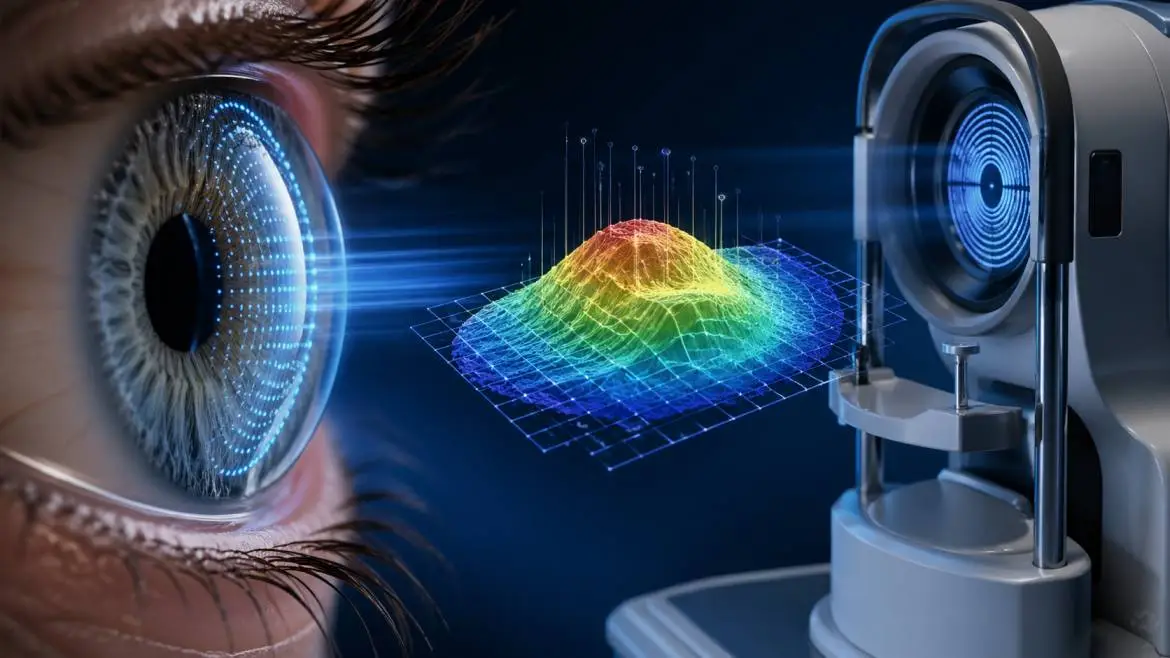
Patients often ask me what the real difference is between standard LASIK and the premium procedures we offer. The distinction isn't just marketing; it is a fundamental leap in data and precision.
Wavelight Plus achieves superior outcomes by moving beyond your glasses prescription and treating the unique topography of your eye.
It does this by using a diagnostic device called a Topolyzer, which measures 22,000 unique elevation points across your cornea.
This creates a highly detailed 3D map of all the microscopic hills and valleys on your eye's surface.
This data is then used to create a personalised laser ablation profile that not only corrects your refractive error but also smooths out these tiny irregularities, resulting in a quality of vision that is often sharper and clearer than what can be achieved with glasses or contact lenses.
In this article
- LASIK reshapes the cornea to correct nearsightedness, farsightedness, and astigmatism.
- The procedure is FDA-approved, safe, and uses modern laser technology for precision.
- Candidates should be over 18, have a stable prescription, and healthy corneas.
- Short-term side effects can include dry eyes, halos, glare, or temporary vision fluctuations.
- Most patients achieve stable, long-term vision improvement and are satisfied with results.
- LASIK doesn’t stop natural age-related changes, so reading glasses may still be needed later.
Quick Summary
- Beyond Prescription: Wavelight Plus (Contoura Vision) doesn't just treat your spectacle power. It treats the unique shape of your cornea, correcting microscopic irregularities that cause glare and poor night vision.
- The 22,000-Point Map: A device called a Topolyzer measures 22,000 individual elevation points on your cornea's surface, creating an ultra-high-resolution 3D map.
- The Goal is Smoothness: This detailed map allows the laser to create a perfectly smooth and optically ideal corneal surface, which is why a significant number of patients achieve vision better than 6/6 (20/20).
- Data-Driven Precision: Unlike older technologies that treat all eyes with the same prescription identically, Wavelight Plus creates a surgical plan that is 100% unique to your individual eye.
- The Result: A reduction in higher-order aberrations, leading to crisper night vision, reduced halos, and a higher overall quality of vision.




(Put Real times images and shorts of Dr Avdaith Sai Consulting, Operating on Patients)

Watch Patient Journeys

Visit Our Centre
What is the difference between standard LASIK and Contoura (Topography-Guided) LASIK?
In my decade of surgical practice at Envision LASIK Centre, I've witnessed the evolution of laser technology firsthand.
To understand the significance of Wavelight Plus, we first need to appreciate the limitations of what came before it.
The "One-Size-Fits-All" Approach of Standard LASIK
Traditional LASIK and even early Wavefront-Optimized LASIK work on a simple principle: they treat your prescription.
If you and another patient both have a prescription of -5.00 D, the laser will apply the exact same ablation pattern to both eyes.
- The Flaw: This approach assumes that both corneas are perfectly shaped, differing only in their refractive power. This is biologically incorrect. Every cornea has a unique landscape of microscopic peaks and valleys. These are known as higher-order aberrations (HOAs). Glasses and contact lenses cannot correct these; they only correct lower-order aberrations (myopia, hyperopia, and astigmatism).
- The Consequence: Standard LASIK can sometimes even increase these HOAs, leading to post-operative complaints of glare, halos, or starbursts around lights, especially at night.
Are You the Right Candidate for LASIK?
Fill the form & we will tell you if LASIK is right for you. Its Free!
The Wavelight Plus Innoveyes Revolution: Treating the Individual
Wavelight Plus fundamentally changes the paradigm. It says, "Your prescription is important, but the unique shape of your cornea is paramount."
Instead of treating the prescription, it treats the topography.
It aims to transform your unique, irregular cornea into a perfectly smooth, optically ideal shape, while also correcting the refractive error.
This is a far more sophisticated approach, akin to the difference between buying a suit off the rack and getting one tailor-made. The 22,000 data points are the tailor's measurements.
How wavelight plus innoveyes is better than all LASIK techniques?
The WaveLight Plus InnovEyes system surpasses all traditional LASIK techniques by leveraging advanced wavefront-guided technology in combination with its corneal topography-driven approach.
Unlike conventional LASIK, which primarily focuses on addressing the patient’s prescription, WaveLight Plus InnovEyes meticulously maps the unique curvature of each cornea with unparalleled precision.
By utilising the 22,000-point data analysis, it crafts a bespoke treatment plan tailored specifically to the individual.
This ensures not only the correction of refractive errors but also the optimisation of overall visual quality, minimising issues such as halos and glare.
The result is a truly personalised laser vision correction experience that achieves exceptional clarity while prioritising the integrity of the cornea.
How Does the Topolyzer Capture 22,000 Data Points?
The engine behind Wavelight Plus is the Alcon Topolyzer VARIO Diagnostic Device. This is the machine that captures the high-resolution map of your cornea.
The Placido Disc Principle:
The technology is based on a concept developed in the 19th century by António Plácido.
- The Projection: The device projects a series of 22 concentric, illuminated rings onto your cornea.
- The Reflection: A camera captures the reflection of these rings off your tear film, which perfectly follows the shape of your corneal surface.
- The Analysis: If your cornea were perfectly spherical, the reflected rings would be perfect, evenly spaced circles. However, on a real cornea, these rings are distorted. Where the cornea is steeper, the rings appear closer together. Where it is flatter, they are farther apart.
- The Calculation: Sophisticated software analyses the shape and spacing of these 22 reflected rings. By calculating the deviation of these rings from a perfect circle at thousands of points, it builds the elevation map. It is a form of advanced computerised photogrammetry for the eye.
From Rings to 22,000 Points:
The device's software segments the 22 rings into thousands of individual data points. For each point, it calculates the precise elevation relative to a reference sphere.
This gives us a map of peaks (positive elevation) and troughs (negative elevation) with an accuracy of less than a micron.
This process provides the two critical pieces of information needed for the treatment plan:
- Topography Map: The map of the corneal irregularities.
- Refractive Power: The patient’s prescription is also integrated into the planning.
The laser then calculates the most efficient way to ablate tissue to achieve two goals simultaneously: correct the prescription and regularise the corneal surface.
How is my eye data used to create a personalised laser treatment plan?
Once the 22,000-point map is captured, it is transferred to the Wavelight EX500 Excimer Laser. Here, the surgeon plans the treatment.
The Integration of Data:
The laser's planning software overlays the topography map with your refractive data (your prescription). It then creates a unique ablation plan.
- The Analogy: Imagine you have a wooden table that is warped (topography) and also too high (refractive error). A simple carpenter might just saw the legs to lower it (standard LASIK). A master craftsman will sand down the high spots and fill in the low spots to make the surface perfectly flat, while also adjusting the leg height (Wavelight Plus).
The Treatment:
The laser doesn't just apply a uniform correction. It applies a variable pattern of pulses.
- It delivers more pulses to the microscopic "hills" on your cornea to flatten them.
- It delivers fewer or no pulses to the "valleys."
The end goal is to create a cornea that is not only the right power but also exceptionally smooth. This smoothness is what scatters less light, leading to a higher quality of vision.
Why Is Corneal Topography Important for the Success of Your Vision Correction?
Is measuring 22,000 points overkill? Absolutely not. This level of detail is directly responsible for the superior outcomes of Wavelight Plus.
1.Achieving "Super-Vision" (Better than 6/6)
The international standard for excellent vision is 6/6 (or 20/20 in the US). In FDA clinical trials for Wavelight Plus (Contoura), the results were remarkable:
- 30.9% of patients achieved vision of 6/4.8 (20/15) or better—this is sharper than what is considered "perfect" vision.
- 64.8% achieved 6/6 vision.
- 92.6% achieved 6/6 or better.
This ability to exceed the 6/6 benchmark is almost exclusively due to the correction of the subtle higher-order aberrations identified by the 22,000-point map.
2.Reducing Night Vision Disturbances
Glare, halos, and starbursts are caused by light scattering as it passes through an imperfect optical system. The cornea is the most powerful lens in this system.
The Cause: Microscopic irregularities on the corneal surface, which are often too small to affect daytime vision in good light, become significant at night when your pupil dilates.
The Solution: By smoothing these irregularities, Wavelight Plus creates a more "perfect" optical surface that scatters less light. In the same FDA study, patients reported a significant reduction in light sensitivity, difficulty driving at night, and glare post-operatively compared to their vision with glasses or contacts pre-operatively.
3.Superior Astigmatism Correction
Astigmatism is essentially an asymmetry in the cornea's curvature. Topography-guided treatment is exceptionally good at correcting astigmatism because it directly measures and treats the surface irregularity, rather than just applying a generic astigmatic correction.
Is Topography-Guided LASIK Better Than Standard LASIK?
Let's consider a practical example I often see at our LASIK centre in Hyderabad.
A 30-year-old IT professional with a prescription of -4.00 D of myopia and -1.00 D of astigmatism.
He complains of significant glare from oncoming headlights when driving at night.
⇒Treatment with Standard LASIK:
- The laser is programmed to correct -4.00 D / -1.00 D.
- It applies a standard ablation profile.
The Likely Outcome: The patient achieves 6/6 vision in the daytime. However, his night vision issues might persist or even slightly worsen because the underlying corneal irregularities causing the glare were not addressed.
⇒Treatment with Wavelight Plus:
- The Scan: We perform a Topolyzer scan. The 22,000-point map reveals his -1.00 D of astigmatism, but also shows a slight "coma-like" aberration (a higher-order irregularity) on his central cornea. This is the real culprit for his night-time glare.
2.The Plan: The laser is programmed not only to correct the myopia and astigmatism but also to apply extra pulses to smooth out the coma aberration.
3.The Outcome: The patient achieves 6/6 vision, and after a few weeks of healing, reports a dramatic improvement in his night driving. The glare from headlights is significantly reduced because the root cause of the light scatter has been eliminated.
This is the tangible difference that data-driven, personalised treatment makes.
How Do I Prepare for My Laser Eye Surgery Mapping Session?
The Topolyzer scan is the most important measurement we will take. To ensure its accuracy, preparation is key.
⇒The "No Contact Lens" Rule:
As discussed in detail, you must stop wearing contact lenses before this scan.
- Soft Lenses: Minimum 7 days.
- Toric/Astigmatism Lenses: Minimum 10-14 days.
- Hard (RGP) Lenses: Minimum 4 weeks.
This allows your cornea to relax back to its true, natural shape. Scanning a cornea that is still moulded by a contact lens will provide false data and compromise your surgical outcome.⇒The Scan Itself:
The scan is completely painless and non-contact.
- You will sit at the machine and place your chin on a chin rest.
- You will be asked to look at a central fixation light inside the device.
- You will see the illuminated rings projected onto your eye.
- You just need to stare straight ahead and blink normally until we tell you to hold your eye open for a few seconds while the image is captured.
- The entire process takes less than a minute per eye.
We will take multiple scans to ensure consistency and accuracy. If we see variability between scans, it is often a sign of dry eye, and we will lubricate your eyes and repeat the measurement.
Every eye is unique. Personalized vision correction matters
The Wavelight Plus (Contoura Vision) system, with its 22,000-point analysis, represents a paradigm shift in refractive surgery.
It elevates the procedure from a generic correction to a truly bespoke art form. It allows us to treat you not as a prescription, but as an individual.
The human eye is as unique as a fingerprint. No two corneas are the same.
By embracing technology that captures this uniqueness in exquisite detail, we can deliver a level of visual quality that was previously unattainable.
We are not just helping you to see; we are optimising the way you see.
At Envision LASIK Centre in Hyderabad, we have invested in this state-of-the-art diagnostic and treatment platform because we believe our patients deserve a surgical plan that is as unique as they are.
The path to superior vision is paved with data, and it starts with those 22,000 points.
Are you ready to see what a map of your own eye looks like?
Book a consultation with us today. We can perform a comprehensive evaluation, including Topolyzer mapping, to determine if you are a candidate for this revolutionary procedure.

Why is Wavelight Plus the Best Treatment for Patients with Irregular Astigmatism?
Discover why Wavelight Plus is ideal for irregular astigmati…
Why Wavelight Plus is Called “Topography-Guided” and Why It Matters for Night Vision?
Wavelight Plus is referred to as “topography-guided” because…

How Artificial Intelligence Helps in Ophthalmic Surgery?
AI in eye surgery boosts precision, safety, and faster recov…