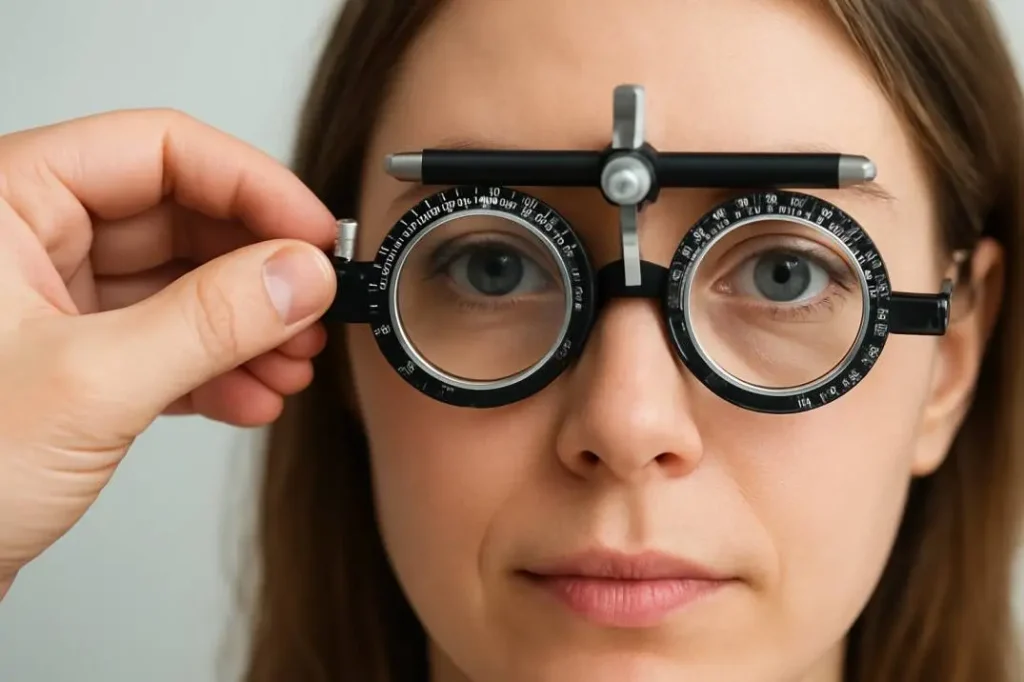
What is the highest level of myopia?
AUTHOR

Ophthalmologist/ Eye Surgeon 13+ Years Exp
MBBS, MS – Ophthalmology
Condition
CALL US 24/7 FOR ANY HELP
GET IN TOUCH ON
If you’ve been told you or your child is “very short-sighted,” it’s natural to wonder how high myopia can go and what it means for long-term eye health. I’ll walk you through this in clear terms, just as I would in the clinic.
We’ll cover what myopia is, the levels (including what counts as high myopia), the risks you should know about, and the treatments that help protect vision.
What is myopia?
Myopia, or short-sightedness, means distant objects look blurry while near objects are clearer. It happens because the eye focuses light in front of the retina instead of on it. The most common reason is an eyeball that has grown longer than average (axial elongation). Less often, the cornea or lens is too curved.
We measure myopia in dioptres (D). You’ll see it on your glasses prescription as a negative number, like -2.00 D. The more negative the number, the stronger the prescription and the higher the level of myopia.
How do we classify the levels of myopia?
There isn’t a single universal cut-off used by every clinician, but these ranges are widely accepted in clinical practice and research:
- Low myopia: -0.50 D to -3.00 D
- Moderate myopia: -3.25 D to -5.75 D (many use -6.00 D as the upper bound)
- High myopia: -6.00 D or more, or an axial length of 26.0 mm or longer
You might also hear the term “pathologic” or “degenerative myopia.” That’s not defined by a prescription number alone. It refers to structural changes in the back of the eye (the retina and choroid) that can occur in some people with long-standing, high myopia.
So, what is the highest level of myopia?
There isn’t a fixed “maximum” number. In real life, prescriptions can exceed -10.00 D, -15.00 D, and even -20.00 D. However, very high numbers are uncommon. More important than the number is what’s happening to the eye’s structure, especially the retina. This is why two people with the same prescription may have different levels of risk depending on axial length and retinal findings.
Think of it this way: the prescription tells us how much focusing power you need to see clearly. The axial length and retinal health tell us about long-term risks. As the eye elongates, the tissues stretch, and that’s where complications can arise.
Why high myopia matters?
High myopia (≥ -6.00 D or axial length ≥ 26.0 mm) increases the lifetime risk of certain eye diseases. This doesn’t mean you’ll develop them, but your risk is higher than someone without myopia. Here are the key conditions we watch for:
- Retinal detachment: The elongated eye stretches the retina, making tears and detachments more likely. Symptoms to act on immediately include flashes of light, a sudden shower of floaters, or a dark curtain in your vision.
- Myopic maculopathy (or myopic macular degeneration): Thinning and changes in the central retina (macula) can cause progressive central vision loss. In some cases, abnormal blood vessels grow (myopic choroidal neovascularisation), which may require anti-VEGF injections.
- Glaucoma: People with high myopia have a higher risk of open-angle glaucoma. Regular pressure checks and optic nerve assessment are important.
- Early cataract: Myopic eyes may develop cataracts earlier. The good news is cataract surgery outcomes are generally excellent, though high myopia requires careful pre-operative measurements.
- Peripheral retinal changes: Lattice degeneration and other weak areas are more common and may need monitoring or, rarely, preventative laser if tears develop.
What raises the risk of developing high myopia?
- Genetics: If one parent is myopic, a child’s risk increases; with two myopic parents, the risk is even higher.
- Environment: Less time outdoors and more prolonged near work in childhood are linked to myopia onset and progression.
- Early onset: The earlier myopia begins, the more time it has to progress, increasing the chance of reaching high myopia.
Evidence shows that extra outdoor time (around 2 hours a day) lowers the risk of developing myopia in children. While outdoor time doesn’t “cure” existing myopia, it’s a useful prevention strategy for younger children and siblings at risk.
How we diagnose and monitor high myopia?
Beyond checking your glasses prescription, we may:
- Measure axial length: This is a precise way to track eye growth in children and to quantify risk in adults.
- Examine the retina with dilating drops: Lets us view the peripheral retina and macula carefully.
- Use imaging: Optical coherence tomography (OCT) helps detect subtle macular and optic nerve changes.
- Check eye pressure and optic nerve: Screens for glaucoma.
If your prescription is -6.00 D or higher, or your axial length is 26.0 mm or more, you should have regular eye examinations—often annually or as advised by your optometrist or ophthalmologist.
Can high myopia be treated or managed?
We manage myopia in two ways: correcting vision and slowing progression (particularly in children and teens). For adults with established high myopia, the focus is on optimal vision correction and vigilant monitoring for complications.
Vision correction options
- Glasses: Safe, effective, and customisable. High-index lenses and aspheric designs reduce thickness and weight.
- Contact lenses: Daily disposable lenses are convenient; specialty designs can improve comfort and optics in higher prescriptions.
- Refractive surgery: Options include LASIK, PRK, SMILE, or phakic IOLs (implantable contact lenses). Suitability depends on corneal thickness, prescription range, age, stability, and ocular health. Phakic IOLs are often considered for very high prescriptions beyond the safe range for corneal laser procedures. Even after refractive surgery, the underlying axial length and retinal risks remain, so regular eye checks are still essential.
Myopia control in children and teens
Slowing progression during growth years reduces the chance of reaching high myopia. Evidence-based methods include:
- Low-dose atropine eye drops (typically 0.01% to 0.05%): Shown to slow myopia progression with manageable side effects like mild light sensitivity or near blur at higher doses.
- Orthokeratology (night lenses): Rigid lenses worn overnight reshape the cornea temporarily, giving clear daytime vision and slowing progression in many children.
- Special myopia-control spectacles and soft contact lenses: Designs with peripheral defocus or multiple segments have been shown to slow progression.
- More outdoor time: Aim for at least 2 hours daily where possible, along with sensible breaks during near work (e.g., 20-20-20 rule: every 20 minutes, look at something 20 feet away for 20 seconds).
Your child’s plan should be individualised, combining options where appropriate and tracking axial length and prescription every 6–12 months.
Is “pathologic myopia” the same as high myopia?
Not always. High myopia describes the level of refractive error or axial length. Pathologic myopia refers to the structural damage it can cause, such as lacquer cracks, posterior staphyloma, myopic macular degeneration, or tractional changes in the macula (myopic traction maculopathy).
Someone can have high myopia without pathologic changes; others may develop pathologic changes at moderate levels if the eye is particularly susceptible. This is why retinal evaluation is key.
Everyday tips if you have high myopia
- Keep your annual eye exam: If you notice sudden changes—flashes, floaters, a shadow—seek urgent care.
- Protect your eyes: Wear sunglasses outdoors to reduce UV exposure.
- Use good lighting: Helps reduce eye strain during reading or computer work.
- Optimise ergonomics: Keep screens at a comfortable distance and take frequent breaks.
- Share family history: It helps your clinician tailor your monitoring and management.
Key takeaways
- There’s no single “highest” level of myopia, but -6.00 D or an axial length of 26.0 mm and above is considered high myopia.
- The main concern isn’t the number itself—it’s the increased risk of retinal and optic nerve problems as the eye elongates.
- Regular monitoring and early treatment of complications protect vision.
- In children and teens, myopia control strategies can meaningfully slow progression and reduce the chance of reaching high myopia.
- Adults with high myopia can enjoy excellent vision with the right correction and ongoing care.
When to seek help urgently?
- New flashes of light, a sudden increase in floaters, or a curtain/shadow in your vision
- Sudden, painless loss of central vision
- Any eye pain with blurred vision
If you’re unsure, it’s always safer to get checked.
Conclusion: What to do next
If you or your child has a high prescription, book a comprehensive eye examination with dilating drops and, if available, axial length measurement. Ask about your individual risk and a monitoring plan.
For children, discuss myopia control options and make outdoor time part of the routine. With proactive care, most people with high myopia maintain good vision and lead full, active lives.
AUTHOR
Ophthalmologist/ Eye Surgeon 13+ Years Exp
MBBS, MS – Ophthalmology
Condition
CALL US 24/7 FOR ANY HELP
GET IN TOUCH ON