
Are “vision improvement” apps actually effective or just pseudoscience?
Can vision apps really improve eyesight? Learn what science says, what they can’t fix, and proven ways to protect your eye health.
Medically Reviewed By:
Dr Advaith Sai Alampur
Leading LASIK & Refractive Surgery Expert
Condition:
Myopia
(Near sightedness)
Treatment:
LASIK
(Laser Eye Surgery)


If you’ve scrolled past ads promising sharper vision with a few minutes of “eye training” a day, you’re not alone. As a clinician, I’m often asked: can an app really fix your sight, or is it too good to be true? Let’s walk through what these apps claim, what the science says, and what you can do to protect your eyes for the long haul.
What you’ll learn:
- How vision actually works (and what can and can’t be “trained”)
- The most common vision problems and why they occur
- What “vision improvement” apps promise versus the evidence
- Evidence-based ways to maintain and, in some cases, improve visual function
- A balanced view on when these apps might help—and when they won’t
In this article
- LASIK reshapes the cornea to correct nearsightedness, farsightedness, and astigmatism.
- The procedure is FDA-approved, safe, and uses modern laser technology for precision.
- Candidates should be over 18, have a stable prescription, and healthy corneas.
- Short-term side effects can include dry eyes, halos, glare, or temporary vision fluctuations.
- Most patients achieve stable, long-term vision improvement and are satisfied with results.
- LASIK doesn’t stop natural age-related changes, so reading glasses may still be needed later.
How vision works (quick and clear)
Your eye is a finely tuned optical system:
- The cornea and lens focus light onto the retina.
- The retina converts light into electrical signals.
- The optic nerve carries those signals to the brain, which forms the image you “see.”
Two key ideas matter here:
1) Optical clarity: The shape of your eye and lens determines if light focuses precisely on the retina. If it doesn’t, you get refractive errors: short-sightedness (myopia), long-sightedness (hyperopia), and astigmatism.
2) Neural processing: The brain and retina can adapt to how you use your vision. This neural side is where training might make a difference.
In simple terms: apps can’t change the length of your eyeball or the curve of your cornea. But certain types of training might help your visual processing or comfort in specific situations.




(Put Real times images and shorts of Dr Avdaith Sai Consulting, Operating on Patients)

Watch Patient Journeys

Visit Our Centre
Common vision problems—and what causes them
- Myopia (short-sightedness): The eye is too long or the cornea too curved, so distant objects look blurry. This is an optical issue. Glasses, contact lenses, or refractive surgery correct the focus. Myopia often develops in childhood and can progress.
- Hyperopia (long-sightedness): The eye is too short or the cornea not curved enough. Near tasks can be hard, especially as you age.
- Astigmatism: The cornea or lens isn’t perfectly spherical, causing distorted vision at all distances.
- Presbyopia: From about your 40s, the lens stiffens and near focus becomes harder. Reading glasses, multifocals, or contact lens options help.
- Amblyopia (“lazy eye”) and strabismus (eye turn): Brain and binocular vision issues that often need targeted therapy, especially in childhood.
- Digital eye strain: Not a refractive error, but common. Symptoms include tired eyes, headaches, and dry eye after long screen sessions.
Only some of these have any plausible link to “training.”
Are You the Right Candidate for LASIK?
Fill the form & we will tell you if LASIK is right for you. Its Free!
What do “vision improvement” apps claim?
Most apps fall into a few buckets:
- Eye exercises to “cure” myopia or reduce your prescription
- Brain-training or perceptual learning games to sharpen acuity or contrast sensitivity
- Focus or accommodation exercises for near work comfort
- Eye yoga or muscle workouts to “strengthen” your eyes
- Blue light filters or routines to prevent eye strain and sleep disruption
The red flag is sweeping claims like “throw away your glasses in weeks.” Your glasses exist to fix optical focus. No app can shorten your eyeball or smooth out astigmatism.
What the science says—separating the signal from the noise
Where apps do NOT help:
- Refractive errors (myopia, hyperopia, astigmatism) are optical. There’s no credible evidence that app-based exercises change your
- prescription in a lasting way.
Presbyopia (age-related near focus loss) isn’t reversed by exercises. Some people may feel temporary comfort gains, but you still need optical help.
Where apps MAY help (with limits):
- Perceptual learning: Repeated visual tasks can improve performance on trained activities—think contrast detection or letter recognition under certain conditions. Studies show small, task-specific gains, especially in young adults. But real-world improvements (like reading a smaller line on the standard eye chart at your annual exam) tend to be modest and may not transfer broadly.
- Amblyopia therapy in children: Digital tools and games can support patching and targeted visual tasks under clinician guidance. This is a specific medical use, not a general “vision app” cure.
- Convergence insufficiency and near focus discomfort: Structured, evidence-based vision therapy—often supervised by an optometrist—can help with specific binocular vision disorders. Some home-based digital programmes are part of care, but they are not generic consumer apps and should be prescribed.
- Digital eye strain: Apps that prompt breaks, guide lighting/contrast settings, or nudge blinking can reduce symptoms. They don’t change your prescription, but they can improve comfort.
- Blue light filters: Blue light from screens does not damage the retina at levels emitted by consumer devices. However, evening blue light can delay sleep onset. Night mode or app-driven warm settings can help sleep for some people. For eye comfort, dryness and reduced blink rate matter more than blue light itself.
The “eye muscle” myth
You’ll see exercises claiming to “strengthen” your eye muscles to fix blur. For clarity: the muscles that move your eyes are not the reason you need glasses.
They aim your eyes; they don’t focus images sharply on the retina. The tiny muscle inside the eye (ciliary muscle) adjusts focus for near tasks, but repeatedly flexing it won’t fix a long eyeball or a misshapen cornea.
How some people feel “better” after using these apps?
Why do some users report crisper vision?
- Attention and motivation: Focusing on visual tasks can make you more aware and reduce careless errors on charts.
- Short-term accommodation changes: After near-work exercises, young eyes can transiently alter focus.
- Lighting and ergonomics: Apps often suggest better habits that truly improve comfort and perceived clarity.
- Practice effects: You get better at the trained test, not necessarily at seeing in general.
These improvements are usually subtle and may fade when you stop training.
Evidence-based ways to look after your eyes
If you’re keen to do something that actually helps, here’s what works:
- Regular eye exams: Every 1–2 years, or sooner if you have symptoms. Early detection of glaucoma, macular disease, and diabetic eye disease is crucial.
- Correct your prescription: Proper glasses or contacts reduce eye strain, headaches, and accidents.
- Myopia control in children: Options like low-dose atropine drops, orthokeratology, and specially designed multifocal contact lenses can slow progression. Outdoor time (at least 90–120 minutes daily) is linked to lower myopia risk.
- The 20-20-20 rule: Every 20 minutes, look 20 feet away for 20 seconds. This eases near-focus demand and reduces digital eye strain.
- Blink and hydrate: Conscious blinking, lubricating drops if needed, and keeping screens slightly below eye level help dry eye symptoms.
- Ergonomics: Good lighting, larger text size, appropriate contrast, and proper screen distance (about an arm’s length).
- Nutrition and lifestyle: For long-term retinal health, don’t smoke. Eat leafy greens, colourful fruits/veg, and omega-3 sources. Manage blood pressure, cholesterol, and blood sugar. Maintain a healthy weight and exercise regularly.
- UV protection: Wear quality sunglasses outdoors to reduce cataract and macular degeneration risk.
- Sleep: Consistent sleep supports visual comfort. Reduce bright screen exposure 1–2 hours before bed.
When a vision app might be worth it?
- For comfort: Break reminders, blink trainers, and ergonomic guides can reduce symptoms during heavy screen use.
- For specific conditions: If a clinician recommends a digital programme for amblyopia or binocular vision therapy, it can be a helpful part of treatment.
For performance in defined tasks: Perceptual learning can improve certain visual skills for sports or gaming, though gains are often narrow and may plateau. - Set expectations: these apps are tools for comfort or training, not cures for refractive error.
Red flags to watch for
- Promises to “throw away your glasses” or “reverse myopia in weeks”
- Lack of clinical trials, or only testimonials
- One-size-fits-all plans for complex problems
- Pressure to stop proven treatments (glasses, contacts, myopia control, patching)
- Expensive subscriptions without clear, measurable goals
So… are vision improvement apps effective or pseudoscience?
It’s not all-or-nothing. Many mass-market “fix your eyesight” claims are exaggerated and drift into pseudoscience. Apps cannot reshape your eye or replace glasses, contacts, or surgery for refractive errors. However, some app-based tools can help with:
- Visual comfort and habits
- Sleep hygiene via night modes
- Specific, clinician-guided therapies
- Task-specific perceptual gains
Think of them as accessories, not core treatment.
What I recommend if you’re curious?
- Start with an eye exam to rule out a correctable issue or a medical problem.
- If you try an app, choose one with clear goals: break reminders, blink training, or clinician-backed therapy.
Track measurable outcomes: symptom diaries, reading time without discomfort, or validated questionnaires (e.g., CVS-Q for digital eye strain). - Keep using proven methods: the right prescription, good ergonomics, outdoor time for kids, UV protection, and healthy lifestyle choices.
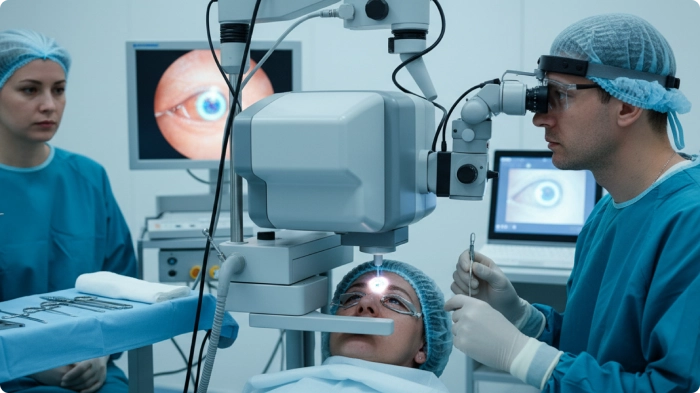
LASIK for Pilots in India: A Guide to Vision Standards & Safety
LASIK for pilots in India: DGCA rules, Armed Forces standard…
AI in LASIK Surgery: How Artificial Intelligence Is Transforming Vision Correction (2026)
SMILE Pro preserves 80% more corneal nerves than LASIK by us…
Environmental Factors and LASIK Outcomes: How Pollution and UV Exposure Influence Success and Longevity
Learn how pollution and UV exposure affect LASIK outcomes, h…