

What Happens If I Blink During the SMILE Pro 10-Second Laser?
AUTHOR

Ophthalmologist/ Eye Surgeon 13+ Years Exp
MBBS, MS – Ophthalmology
TREATMENT
CALL US 24/7 FOR ANY HELP
GET IN TOUCH ON
The short answer is: You physically cannot blink during the laser emission, and even if you try, the procedure remains perfectly safe.
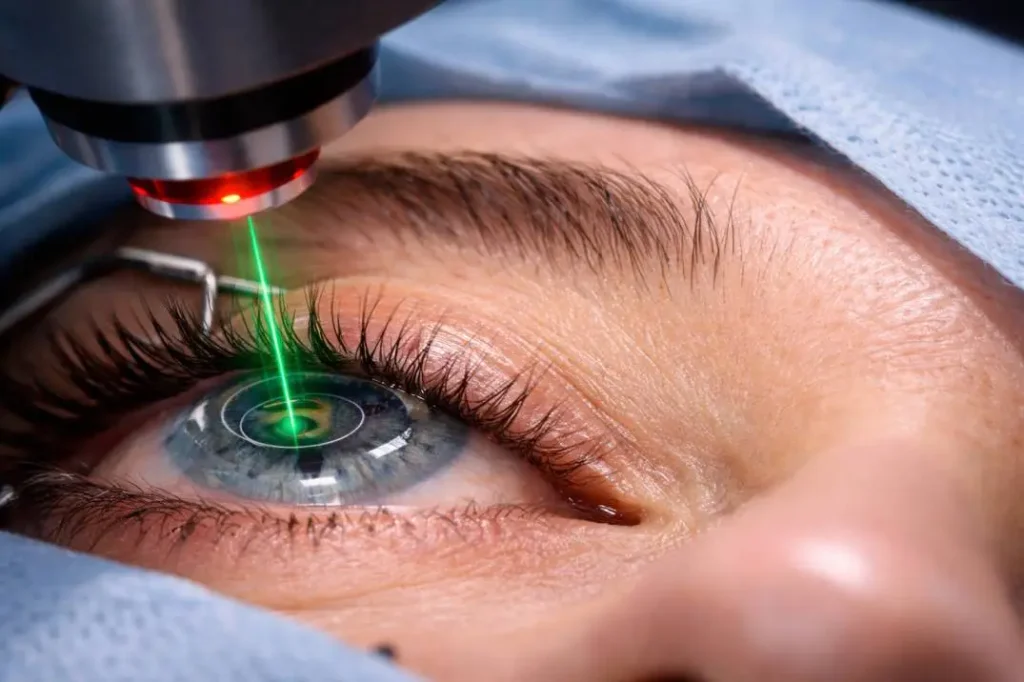
This is not because of willpower, but because of advanced engineering. Before the laser begins, a specially designed curved contact glass is gently docked onto your eye using low-pressure suction.
This mechanism effectively holds your eyelids open and stabilises the eye, making it physically impossible for your eyelids to close over the treatment zone.
Furthermore, the VisuMax 800 laser used for SMILE Pro completes the entire lenticule creation in just 8 to 10 seconds.
In the extremely rare event that suction is lost due to sudden, forceful movement, the laser system has an instant safety cut-off.
It stops immediately, allowing us to simply re-dock and resume or switch strategies without harming your vision.
Quick Summary
- Physical Impossibility: A gentle suction device holds your eye and eyelids open, making it physically impossible to blink over the laser field.
- The 10-Second Speed: The VisuMax 800 is incredibly fast. The laser part is often over before you even process the urge to move or blink.
- Intelligent Cut-Offs: If you make a massive movement that breaks suction, the machine stops instantly. It does not “fire blindly” or damage surrounding tissue.
- Suction Stability: Unlike LASIK, which requires high suction that blacks out vision, SMILE Pro uses low suction. You can still see the fixation light, which helps keep you calm and centered.
- No “Do-Overs” Needed: In most cases of suction loss (which is rare), we can re-dock immediately. Your vision is not compromised.
The Anatomy of a Blink: Why It's Your Biggest Fear
In my decade of performing refractive surgeries at Envision LASIK Centre in Hyderabad, “What if I blink?” is the single most common question asked by patients.
It is a valid fear. Blinking is a reflex, a protective mechanism wired deep into our brain stem. The idea of holding your eyes open while a laser operates feels counter-intuitive and frightening.
However, as a surgeon, I need you to understand that we never rely on your self-control for safety. If the success of the surgery depended on a nervous patient holding perfectly still for 10 seconds, I would never operate.
The Reflex Arc:
A blink typically takes about 100 to 150 milliseconds. It is triggered by dryness, foreign objects, or bright lights. In a standard setting, you blink 15-20 times a minute.
In the operating room, we bypass this reflex completely through two methods:
- Anaesthetic Drops: We numb the surface of the eye (cornea). You lose the sensation of “needing” to blink because the eye doesn’t feel dry or irritated.
- The Speculum: We use a small, spring-loaded device called a speculum to gently hold the eyelids apart. This is the first line of defence. Even if you try to squeeze your eyes shut, the speculum resists the pressure.
But with SMILE Pro, we go a step further. The laser interface itself acts as the ultimate stabilizer.
The “Docking” Mechanism: Why You Physically Can’t Close Your Eye
SMILE Pro (Small Incision Lenticule Extraction) is unique because it is a “contact” laser procedure.
The Curved Interface:
The VisuMax 800 laser has a treatment pack with a curved contact glass that mimics the natural shape of your cornea.
When the surgery begins, I guide the laser down until this glass makes gentle contact with your eye.
The Suction Ring:
Once contact is made, a low-pressure vacuum is engaged. This “docks” the eye to the laser.
- Stability: This suction holds the eye firmly in position. It prevents the eye from rolling (looking left or right).
- Blink Barrier: Because the laser cone is physically touching your eye and suctioned onto it, there is literally no space for your eyelid to slide underneath. Your eyelid might twitch against the outside of the laser cone, but it cannot obstruct the laser beam.
Think of it like placing a cup over an object on a table. You can wave your hand around the cup, but you cannot touch the object inside. The laser happens inside the “cup.”
The VisuMax 800 Advantage: Speed is Safety
One of the reasons we invested in the VisuMax 800 at Envision LASIK Centre is its blistering speed. In older versions of SMILE (VisuMax 500), the laser time was around 25-30 seconds. While that is still fast, 30 seconds gives a patient time to overthink, panic, or feel claustrophobic.
The 10-Second Revolution:
The VisuMax 800 operates at a frequency of 2 MHz (2 million pulses per second).
It creates the lenticule (the disc of tissue we remove to correct vision) in just 8 to 10 seconds.
Why Speed Matters for Anxiety:
- Seconds 0-3: You are focused on the green light.
- Seconds 4-7: You might wonder, “Is it starting?”
- Seconds 8-10: I say, “Perfect, laser is done.”
Before your brain has time to trigger a panic response or a forceful blink reflex, the critical part of the surgery is over. This speed drastically reduces the window of opportunity for any patient movement, making “suction loss” statistically much less likely than in slower procedures.
Suction Loss: The “Worst Case Scenario” That Isn’t Scary
Let’s address the elephant in the room. What if you squeeze your eyes so hard, or jerk your head so violently, that you break the suction seal? This is called Suction Loss.
It sounds terrifying, but in 2026, it is a managed, programmed event. It is not a disaster.
The Safety Cut-Off:
The laser computer monitors vacuum pressure thousands of times per second. If the pressure drops even slightly below the safety threshold:
- Instant Stop: The laser beam cuts off immediately. It does not continue firing. It does not fire into the wrong tissue.
- Release: The docking mechanism releases the eye.
What Happens Next?
It depends on when the suction was lost.
- Scenario A (Most Common): Suction loss happens early (e.g., in the first 2-3 seconds).
- Solution: We simply wipe the eye, calm you down, re-dock the laser, and restart the procedure immediately. It’s like pressing “pause” and “restart.”
- Scenario B: Suction loss happens midway.
- Solution: Depending on how much of the lenticule was cut, we might switch to LASIK (using the same machine) or delay the procedure for a few weeks to allow the gas bubbles to dissipate.
In my practice, suction loss occurs in less than 0.5% of cases. Even when it does, it has never resulted in blindness or permanent damage. It is an annoyance, not a catastrophe.
Comparing Safety Protocols: SMILE Pro vs. LASIK vs. PRK
Different procedures handle patient movement differently. Understanding this comparison highlights why SMILE Pro is often the preferred choice for anxious patients.
Feature | SMILE Pro (VisuMax 800) | LASIK (Wavelight/Femto) | PRK / Surface |
Fixation Method | Docked (Contact). Eye is physically held by the laser. | Tracker-Based (Non-Contact). Laser tracks eye movement. | Tracker-Based. No physical hold. |
Blink Prevention | Absolute. Suction cone prevents lid closure. | Speculum Only. Patient must stare at light. | Speculum Only. Patient must stare. |
Laser Time | ~10 Seconds. Extremely fast. | Variable. 2-10 seconds for flap; 5-40 seconds for ablation. | Slower. Can take 30-60 seconds. |
Patient Experience | “Low Suction.” Vision remains grey/blurry but visible. | “High Suction.” Vision blacks out completely during flap creation. | No suction sensation during laser. |
Safety Net | Suction Loss stops laser. No misplaced shots. | Tracker stops laser. Eye movement is followed. | Tracker stops laser. |
The LASIK Difference:
In Femto-LASIK, the suction used to create the flap is very high pressure. This typically causes your vision to go completely black for about 20 seconds.
For many patients, losing vision triggers panic (“Have I gone blind?”).
SMILE Pro uses a curved, low-pressure suction. You do not lose your vision. You can still see the fixation light throughout the 10 seconds.
This visual feedback is incredibly reassuring and helps patients stay calm and focused, reducing the urge to squeeze or blink.
Clinical Insights: Real Patient Reactions in the Operating Room
I want to share a story from my Hyderabad clinic that illustrates this perfectly.
The Case of Mr. Varma (name changed):
Mr. Varma, a 29-year-old financial analyst, was a “squeezer.” In the pre-op exam, every time I brought a light near his eye, he would clamp his eyes shut. He was terrified of the laser.
The Strategy:
I chose SMILE Pro specifically for him because of the docking stability.
- On the Table: As the laser descended, he started to squeeze his eyes.
- The Mechanism: The speculum held his lids. As the VisuMax contact glass touched his eye, the suction engaged.
- The Reaction: He tried to squeeze again. But the laser interface was already locked on. His eyelids pressed against the plastic cone, not his eye.
- The Result: I spoke to him calmly: “10 seconds… 5 seconds… done.”
Before he could work up the panic to jerk his head, the laser had finished.
Post-Op:
He sat up and asked, “When do we start?” He hadn’t even realized the laser part was over.
This is the power of the technology. It accommodates human anxiety. It doesn’t demand that you be a statue; it ensures safety even if you aren’t.
Conclusion: Trust the Technology, Not Just Your Willpower
If you are hesitating to book your refractive surgery because you don’t trust yourself to keep your eyes open, let me reassure you: We don’t trust you to either.
That sounds harsh, but it is the basis of medical safety. We design our protocols assuming that patients will be nervous, that eyes will twitch, and that reflexes will fire.
- We use speculums to defeat the blink.
- We use suction to defeat eye movement.
- We use speed (10 seconds) to defeat anxiety.
- We use trackers and cut-offs to defeat the unexpected.
SMILE Pro on the VisuMax 800 is the pinnacle of this safety philosophy. It takes the burden of “performing” off your shoulders. Your only job is to lie there and breathe. The machine and I will handle the blinking, the movement, and the precision.
At Envision LASIK Centre in Hyderabad, we have performed thousands of these procedures. We have seen every type of nervous patient, and we have safely guided every single one of them to 20/20 vision.
Don’t let a reflex hold you back from a lifetime of clear vision.
AUTHOR
Ophthalmologist/ Eye Surgeon 13+ Years Exp
MBBS, MS – Ophthalmology
TREATMENT
CALL US 24/7 FOR ANY HELP
GET IN TOUCH ON