

SMILE Pro Success Rates: How Successful Is SMILE Pro Eye Surgery?
AUTHOR

Ophthalmologist/ Eye Surgeon 13+ Years Exp
MBBS, MS – Ophthalmology
TREATMENT
CALL US 24/7 FOR ANY HELP
GET IN TOUCH ON
A Surgeon’s Perspective on Precision & Outcomes
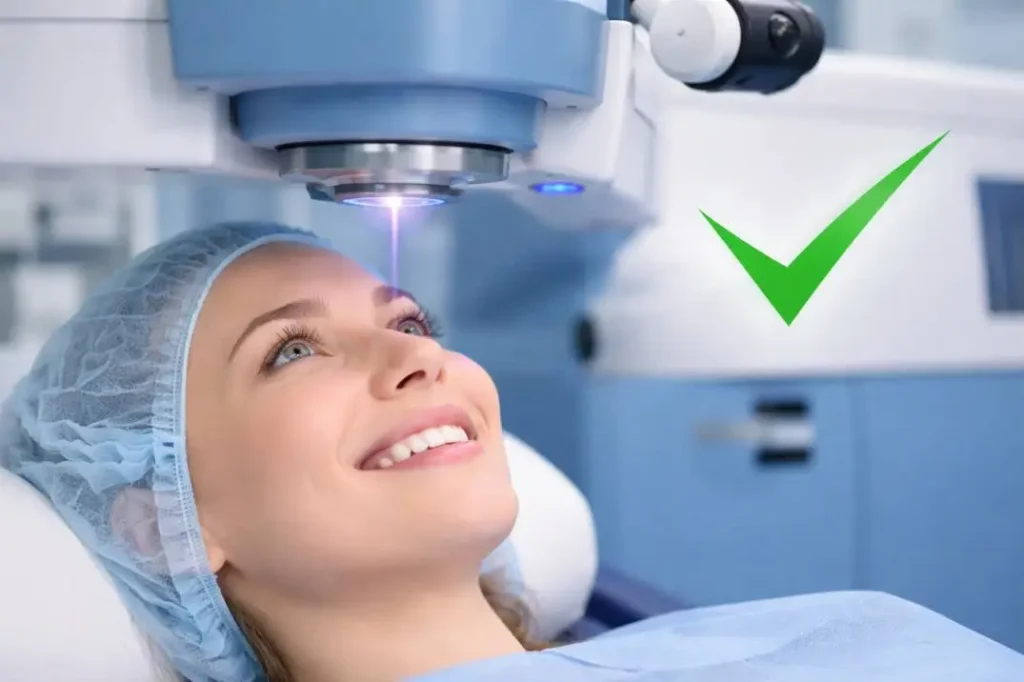
SMILE Pro eye surgery is highly successful, boasting a patient satisfaction rate exceeding 99% and achieving 20/20 vision or better in the vast majority of cases.
As the latest evolution in laser vision correction, it utilizes the Visumax 800 femtosecond laser to perform the procedure in under 10 seconds per eye, significantly reducing surgical stress and enhancing recovery speed compared to its predecessors.
For patients with myopia (nearsightedness) and astigmatism, it offers exceptional stability and safety, particularly for those with active lifestyles.
Quick Summary: Key Takeaways for Busy Professionals
- High Precision Speed: The laser creates the lenticule in approximately 10 seconds, minimizing suction loss risks and anxiety.
- 99%+ Success Rate: Clinical data consistently shows patient satisfaction rates above 99%, with high stability for myopia correction.
- Tissue Preservation: Being a flapless procedure, it maintains greater corneal biomechanical strength than LASIK.
- Rapid Recovery: Most patients at our Hyderabad clinic resume work and driving within 24-48 hours.
- Ideal Candidate: Best suited for myopia between -0.50D to -10.00D and astigmatism up to -5.00D.
Table of Contents
- What Does “Success” Actually Mean in Laser Eye Surgery?
- How Does the Physics of SMILE Pro Ensure Better Outcomes?
- Is SMILE Pro Safer Than Traditional LASIK or Contoura?
- What Are the Long-Term Visual Outcomes After 5 or 10 Years?
- Who Should Not Get SMILE Pro Surgery? (Contraindications)
- What Real-World Hurdles Do Patients Face During Recovery?
- Why Choose Envision LASIK Centre in Hyderabad?
- Frequently Asked Questions
What Does "Success" Actually Mean in Laser Eye Surgery?
In my decade of practice at Envision LASIK Centre,hyderabad, I often see patients who equate “success” solely with reading the bottom line of an eye chart. However, from a clinical perspective, success is a triad of three critical factors: Safety, Efficacy, and Predictability.
When we look at global data, SMILE (Small Incision Lenticule Extraction) procedures have demonstrated efficacy indices often exceeding 0.95.
This means the post-operative uncorrected vision is almost identical to (or sometimes better than) the best-corrected vision the patient had with glasses before surgery.
The Metrics That Matter?
For the analytical minds among you, here is what we look for:
- Efficacy Index: Post-op uncorrected visual acuity / Pre-op best-corrected visual acuity. Ideally, this should be surgeon \ge 1.0surgeon .
- Safety Index: Post-op best-corrected visual acuity / Pre-op best-corrected visual acuity. A value of surgeon \ge 1.0surgeon indicates no loss of visual potential.
In our Hyderabad facility, we consistently observe that SMILE Pro patients achieve safety indices well above 1.0. This suggests that not only are patients seeing without glasses, but the quality of their vision—contrast sensitivity and night vision—is preserved or enhanced because the corneal surface remains largely intact.
How Does the Physics of SMILE Pro Ensure Better Outcomes?
To understand why SMILE Pro is successful, you must understand the mechanics. Unlike LASIK, which relies on creating a corneal flap (essentially a hinged door on the eye’s surface), SMILE Pro is a keyhole procedure.
Using the Visumax 800 laser, we create a microscopic, disc-shaped piece of tissue (called a lenticule) inside the cornea. The volume of this lenticule is calculated based on your refractive error. The formula generally follows:
Tissue Removed (microns) = 15 x Diopters of Correction + 10
This lenticule is then removed through a tiny incision less than 4mm wide.
How Does Speed Impact Safety?
The “Pro” in SMILE Pro largely refers to the speed.
The laser frequency operates at 2 MHz, allowing the lenticule creation in roughly 8 to 10 seconds.
In my clinical experience, this speed is a game-changer for patient anxiety.
Often patients are highly anxious, worried about eye movement during surgery.
With older lasers requiring 25+ seconds, fixation loss (the eye moving off-target) was a genuine concern. With SMILE Pro, the procedure was finished before his anxiety could even peak.
The reduced suction time drastically lowers the risk of suction loss, a rare but stressful intraoperative complication.
Is SMILE Pro Safer Than Traditional LASIK or Contoura?
This is the most common question I field during consultations. The answer lies in biomechanics.
The cornea is not uniform; it is stronger in the anterior (front) layers. LASIK involves cutting a flap through these strong anterior layers, which permanently reduces the cornea’s tensile strength by approximately 30-40%.
SMILE Pro, being flapless, leaves the anterior stroma intact. We operate deeper within the cornea. Studies suggest that SMILE maintains significantly higher biomechanical stability compared to LASIK.
The “Dry Eye” Advantage
In typical LASIK procedures, the flap creation severs corneal nerves that signal the tear glands to produce moisture.
This often leads to “neurotrophic dry eye” lasting 3 to 6 months.
In my practice, I have observed a distinct difference with SMILE Pro patients. Because the incision is only 2-4mm (vs. 20mm for a LASIK flap), fewer nerves are severed.
I recently treated a marathon runner who couldn’t afford the irritation of dry eyes during training. Post-SMILE Pro, his tear film stability was nearly back to baseline within three weeks—something rarely seen with traditional LASIK.
Feature | LASIK / Contoura | SMILE Pro |
Incision Size | ~20 mm (Flap) | 2-4 mm (Keyhole) |
Biomechanics | Reduced strength | Higher retention of strength |
Dry Eye Risk | Moderate to High | Low |
Recovery to Sports | 1-2 Weeks (Risk of flap dislocation) | 24-48 Hours |
Laser Time | Variable | ~10 Seconds |
What Are the Long-Term Visual Outcomes After 5 or 10 Years?
Scientific literature and long-term studies on the original SMILE procedure (upon which SMILE Pro is built) show exceptional stability.
Regression—the gradual return of nearsightedness—is a possibility with any refractive surgery, but the rates in SMILE are remarkably low.
The Role of Epithelial Remodeling
The cornea’s surface layer (epithelium) likes to smooth things out. After tissue is removed, the epithelium may thicken to fill the “dip,” slightly altering the correction.
Because SMILE Pro leaves the strong anterior layers intact, the corneal curvature is less prone to unpredictable changes over the years.
In my observation of patients returning for annual check-ups years later, those with high myopia (e.g., -6.00D to -8.00D) tend to show better stability with SMILE than LASIK.
This is likely because the stronger residual cornea resists bulging or warping (ectasia) more effectively.
Who Should Not Get SMILE Pro Surgery? The Contraindications
Transparency is vital in medicine. While SMILE Pro is advanced, it is not a magic wand for everyone.
At Envision LASIK Centre, we turn away approximately 15-20% of patients because they are not suitable candidates.
When SMILE Pro Is Absolute No!
- Corneal Ectasia / Keratoconus: If your cornea is naturally weak or cone-shaped, removing tissue will destabilize it further. We screen strictly for this using topography scans.
- Unstable Refraction: If your glasses prescription has changed by more than 0.50D in the last year, surgery must be postponed.
- Severe Dry Eye Disease: While SMILE is better for dry eye than LASIK, severe, untreated dry eye is a red flag.
- Hyperopia (Farsightedness): Currently, SMILE Pro is primarily approved for Myopia and Astigmatism. While Hyperopic SMILE is under clinical investigation, it is not yet the standard of care globally.
The “Thin Cornea” Scenario
I often see patients who were told they are ineligible for LASIK due to thin corneas and assume they cannot have SMILE either.
This isn’t always true.
Because SMILE leaves the anterior cornea intact, we can sometimes safely operate on slightly thinner corneas than LASIK would allow, provided the residual stromal bed (RSB) calculation satisfies safety protocols:
RSB > 250 – 300 mu/m
However, I prioritize safety above all. If the numbers are borderline, I will recommend an ICL (Implantable Collamer Lens) instead of risking corneal integrity.
What Real-World Hurdles Do Patients Face During Recovery?
While marketing brochures often promise “instant” vision, biological healing is a process. It is important to manage expectations for the first week.
The “Foggy” Vision Phenomenon
Immediately after SMILE Pro, you will see, but it might be like looking through a light fog or a dirty windshield. This is due to microscopic gas bubbles (surgeon CO_2surgeon and surgeon H_2Osurgeon ) created by the laser during the photodisruption process.
- Day 1: Vision is functional but hazy. Most can use a phone but may find screens tiring.
- Day 2-3: The “fog” lifts significantly. Most patients drive themselves to their follow-up appointment.
- Week 1: Vision creates “crispness.”
The Neural Adaptation Phase
I advise my patients, especially those in high-precision jobs like coding or architecture, that while their eyes are 20/20 physically, their brain needs time to adapt.
I remember a graphic designer patient who was panicked on Day 3 because his night vision had halos. This is a common, temporary side effect of corneal swelling (edema).
By the end of week two, as the edema resolved, the halos vanished. Understanding that this is a physiological healing timeline, not a surgical failure, is crucial for your peace of mind.
Why Choose Envision LASIK Centre in Hyderabad?
In a metropolitan hub like Hyderabad, you have choices. However, technology is only as good as the hands that wield it.
At Envision LASIK Centre, we don’t just sell procedures; we provide optical consulting. We are one of the few centers equipped with the Visumax 800 specifically for SMILE Pro.
- Surgeon Expertise: With over 10 years of experience, I personally oversee the planning and execution of every surgery. I do not delegate critical surgical steps.
- Strict Screening: We prioritize your long-term eye health over short-term revenue. If you are not a good candidate, I will tell you directly and explain why.
- Transparent Pricing: No hidden costs for “upgrades” or post-op care.
If you value a scientific, data-driven approach to your vision, we are aligned with your needs.
Frequently Asked Questions
1.Is SMILE Pro painful?
No. We use anesthetic eye drops that completely numb the surface of the eye. You may feel a slight pressure sensation for about 10 seconds while the laser is active, but no sharp pain.
2.How soon can I resume gym or swimming?
You can resume light cardio and gym workouts (keeping sweat out of eyes) after 3 days. For swimming or contact sports, we recommend waiting 2 weeks to prevent infection and allow the incision to seal completely.
3.Can SMILE Pro correct high astigmatism?
Yes. SMILE Pro is FDA-approved to treat astigmatism up to -3.00D, and in many international protocols (including ours), we can treat up to -5.00D effectively. The Cyclotorsion Control in the new Visumax 800 aligns the laser to your astigmatism axis automatically, increasing accuracy.
4.What if I blink during the laser?
The Visumax 800 uses a curved contact glass that gently holds the eye. You cannot blink the eye that is being operated on. If you move excessively, the laser has an automatic cut-off safety mechanism. We can simply restart or switch strategies without harm to your eye.
Ready to see the world with precision?
Your vision is your most valuable sense. Don’t leave it to chance.
Book a Comprehensive Consultation at Envision LASIK Centre, Hyderabad today and let’s determine if SMILE Pro is the right scientific solution for your eyes.
Related: 1.Cost of SMILE Pro Eye Surgery in India
2.SMILE Pro Or LASIK: Which Laser Eye Surgery Saves More Corneal Tissue?
AUTHOR
Ophthalmologist/ Eye Surgeon 13+ Years Exp
MBBS, MS – Ophthalmology
TREATMENT
CALL US 24/7 FOR ANY HELP
GET IN TOUCH ON