

How SMILE Pro Reduces the Risk of Long-Term Dry Eye Compared to LASIK?
AUTHOR

Ophthalmologist/ Eye Surgeon 13+ Years Exp
MBBS, MS – Ophthalmology
TREATMENT
CALL US 24/7 FOR ANY HELP
GET IN TOUCH ON
One of the most persistent concerns patients raise in my clinic is the fear of permanent dry eye after laser vision correction. It is a valid concern, but the technology has evolved significantly to address it.
SMILE Pro reduces the risk of long-term dry eye compared to LASIK primarily because it is a flapless procedure that preserves the majority of the superficial corneal nerves.
In standard LASIK, creating a 20mm circular flap severs approximately 90% of the anterior corneal nerve plexus, disrupting the feedback loop that triggers tear production.
In contrast, SMILE Pro uses a tiny 2-4mm keyhole incision, leaving the anterior corneal surface and its vital nerve network largely intact.
This structural preservation means corneal sensitivity recovers much faster, maintaining a healthier tear film and significantly lowering the incidence of chronic dryness.
Quick Summary
- Nerve Preservation: SMILE Pro involves a small 2-4mm incision compared to LASIK’s 20mm flap, sparing the majority of corneal nerves responsible for tear regulation.
- The Dry Eye Mechanism: Dryness after surgery is often neurotrophic, meaning it results from temporary nerve damage. Less nerve damage in SMILE Pro equals less dryness.
- Faster Recovery: Corneal sensitivity—and thus normal tear production—typically returns to normal within a few weeks after SMILE Pro, whereas it can take 6-12 months after LASIK.
- Ideal for Risk Candidates: For patients who already spend hours in front of screens or have mild pre-existing dryness, SMILE Pro is the statistically safer choice for comfort.
- Hyderabad Climate Factor: In dry or dusty urban environments like ours, preserving tear film stability is crucial for long-term ocular health.
Table of Contents
- Why Does Laser Surgery Cause Dry Eye in the First Place?
- The Anatomy of the Problem: How LASIK Affects Corneal Nerves
- The SMILE Pro Advantage: Engineering Comfort Through Precision
- Scientific Comparison: SMILE Pro vs. LASIK Dry Eye Outcomes
- Who is Most at Risk for Post-Surgical Dry Eye?
- Clinical Insights: Real-World Recovery Patterns at Envision
- Managing Expectations: Is Dry Eye Zero with SMILE Pro?
- Conclusion: Making the Safe Choice for Your Lifestyle
Why Does Laser Surgery Cause Dry Eye in the First Place?
To understand why one procedure is superior, we must first understand the mechanism of the side effect. The cornea is one of the most densely innervated tissues in the human body.
These nerves are not just there for sensation; they play a critical role in the “Lacrimal Functional Unit.”
Think of it as a thermostat. When the corneal nerves sense that the eye is getting dry or exposed to wind, they send a signal to the brain, which then commands the lacrimal glands to produce tears.
The Disruption:
During refractive surgery, some of these nerves are inevitably severed. When this happens, the “thermostat” is temporarily broken.
The cornea may be dry, but the brain doesn’t receive the signal to produce more tears. This condition is known as Laser-Associated Dry Eye (LADE).
While usually temporary, the severity and duration of LADE depend entirely on how many nerves were cut and how quickly they regenerate.
This is where the difference between LASIK and SMILE Pro becomes scientifically undeniable.
The Anatomy of the Problem: How LASIK Affects Corneal Nerves
LASIK (Laser-Assisted In Situ Keratomileusis) has been the gold standard for decades, and it is an excellent procedure. However, its method of accessing the stromal bed has a biomechanical cost.
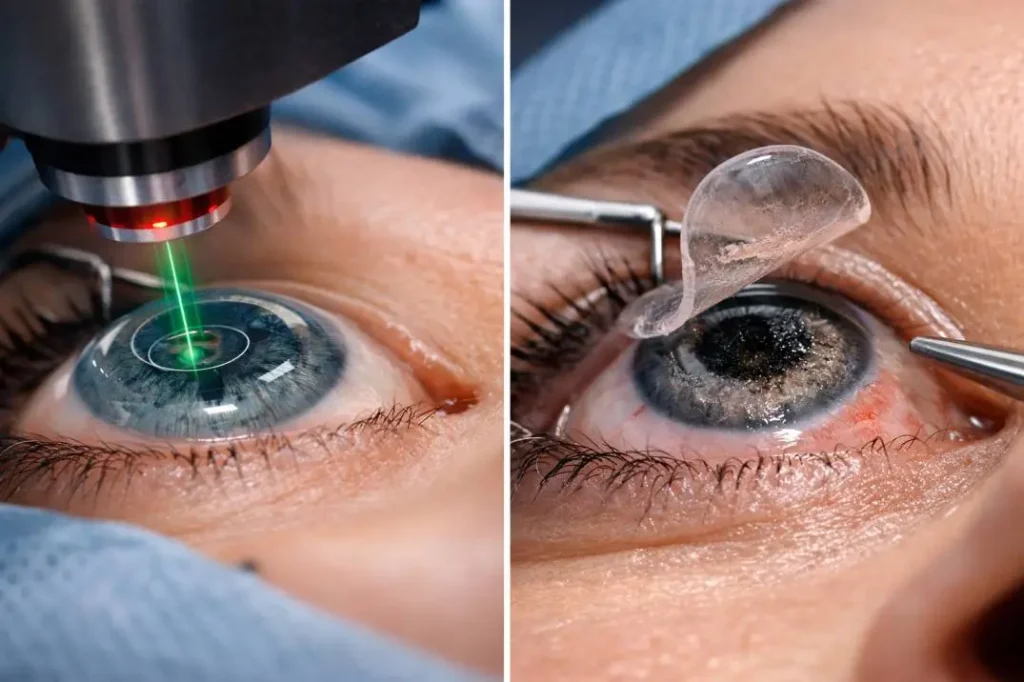
In LASIK, we use a femtosecond laser to create a corneal flap.
- The Incision: This flap creates a circumferential cut that is roughly 20mm to 22mm long.
- The Depth: The cut goes through the epithelium and the anterior stroma, where the sub-basal nerve plexus is most dense.
- The Impact: By creating this flap, we essentially sever the nerve bundles entering the cornea from the sides (except for the small hinge area).
The Result:
Studies show that corneal sensitivity drops significantly immediately after LASIK. It takes time—often 6 to 12 months—for these nerves to regenerate and reconnect across the flap margin. During this period, the tear feedback loop is compromised, leading to symptoms like grittiness, fluctuation in vision, and the need for frequent lubricating drops.
The SMILE Pro Advantage: Engineering Comfort Through Precision
SMILE (Small Incision Lenticule Extraction) Pro represents a fundamental shift in surgical philosophy. Instead of opening the cornea, we work within it.
The Keyhole Technique
Using the VisuMax 800 femtosecond laser, SMILE Pro carves a lenticule (a disc of tissue) inside the stroma. To remove this lenticule, I make a tiny incision—usually just 2mm to 4mm wide.
The Math of Nerve Preservation
Let’s look at the numbers.
- LASIK Incision Length: ~20mm
- SMILE Pro Incision Length: ~4mm
Because there is no flap, the anterior surface of the cornea remains structurally intact. The nerve bundles that travel through the anterior stroma are largely undisturbed, except for the very small area of the keyhole incision.
Why This Matters:
Because the majority of the “thermostat” sensors remain active, the corneal sensitivity is barely affected. The eye continues to signal the brain to produce tears almost normally immediately after surgery. This biomechanical preservation is why SMILE Pro is often referred to as a “dry eye-friendly” procedure.
Scientific Comparison: SMILE Pro vs. LASIK Dry Eye Outcomes
When we look at peer-reviewed data and clinical trials comparing these two modalities, the trend is clear.
Feature | LASIK (Flap-Based) | SMILE Pro (Flapless) |
Incision Circumference | ~20 mm | ~2-4 mm |
Nerve Impact | Severs superficial nerves over 300 degrees. | Spares superficial nerves over 300 degrees. |
Tear Film Stability (TBUT) | Significantly reduced for 3-6 months. | Mild reduction, returns to normal in weeks. |
Corneal Sensitivity Recovery | 6-12 months. | 1-3 months. |
Subjective Dryness Symptoms | Moderate to severe in the first month. | Mild to none in the first month. |
Long-Term Chronic Dry Eye Risk | Extremely low. |
The Ocular Surface Disease Index (OSDI):
In studies using the OSDI (a scale to measure dry eye severity), SMILE patients consistently score lower (better) than LASIK patients at the 1-month and 6-month post-op marks.
Who is Most at Risk for Post-Surgical Dry Eye?
At Envision LASIK Centre in Hyderabad, we screen every patient for dry eye risk before approving them for surgery. Certain demographics are more vulnerable, and for these groups, SMILE Pro is not just an option; it is often the only responsible recommendation.
- The “Screen-Heavy” Professional
If you are a software engineer, data analyst, or gamer spending 10+ hours a day on screens, your blink rate is already reduced. You likely have some degree of evaporative dry eye. Adding a LASIK flap to this baseline can tip you into symptomatic, chronic dryness. SMILE Pro minimizes this additive risk. - Contact Lens Intolerance
Many patients come to me because they can no longer tolerate contact lenses due to dryness. This is a red flag. It indicates the ocular surface is already compromised. Performing LASIK on such an eye is risky. SMILE Pro allows us to correct the vision without exacerbating the intolerance issues.
3. Environmental Factors
Living in a metro like Hyderabad involves exposure to pollution, air conditioning, and dust. All these factors destabilize the tear film. Preserving the natural neuro-lacrimal control mechanism is crucial for comfortable vision in our specific environment.
Clinical Insights: Real-World Recovery Patterns at Envision
In my 10+ years of practice, I have seen thousands of eyes heal. The difference in the “comfort curve” between LASIK and SMILE Pro is palpable.
The LASIK Pattern:
A typical LASIK patient will have excellent vision the next day, but will often say, “Doctor, my eyes feel a bit sandy,” or “I feel like there’s an eyelash in my eye.” I have to prescribe lubricating drops every 2 hours for the first few weeks, tapering off over months. It is manageable, but it is a burden.
The SMILE Pro Pattern:
Contrast this with a recent case. A 35-year-old IT manager came in for his 1-week follow-up after SMILE Pro. I asked him about dryness. He looked confused and said, “I actually forgot to put the drops in yesterday because I didn’t feel anything.”
Because the nerves were intact, his eyes were autoregulating moisture naturally.
Case Study: The Proactive Choice
I recently treated a young woman, 28, who had a history of mild thyroid issues (which can be linked to dry eye). Her tear breakup time (TBUT) was borderline—about 7 seconds (normal is >10).
- The Decision: If I had done LASIK, the nerve severing likely would have dropped her TBUT to 3-4 seconds, causing significant misery.
The Outcome: We chose SMILE Pro. At her 1-month check, her TBUT was stable at 7 seconds. We preserved her baseline. She had zero complaints of burning or irritation.
Managing Expectations: Is Dry Eye Zero with SMILE Pro?
It is critical to be transparent. SMILE Pro reduces the risk, but it does not eliminate it entirely.
Any procedure that alters the curvature of the cornea will temporarily disrupt the tear film distribution. Even with SMILE Pro, patients may experience mild dryness for a few weeks as the small incision heals and the suction pressure from the laser interface resolves.
However, the difference is in chronicity and severity.
- With SMILE Pro: Dryness is usually a transient annoyance that resolves quickly.
- With LASIK: Dryness can be a prolonged condition requiring management for up to a year.
Our Protocol at Envision:
Regardless of the procedure, we optimize the ocular surface before surgery. If you have Meibomian Gland Dysfunction (blocked oil glands), we treat it with warm compresses or IPL therapy first. A healthy foundation ensures the best structural outcome.
Conclusion: Making the Safe Choice for Your Lifestyle
When choosing a refractive surgery, most patients focus on “20/20 vision.” But as a surgeon, I focus on “20/20 happy vision.” Visual acuity is useless if your eyes are constantly burning, red, or tired.
The evolution from LASIK to SMILE Pro is largely a story of biomechanical and neurological preservation. By respecting the corneal nerves, we respect the eye’s natural ability to heal and hydrate itself.
If you have hesitated to get laser vision correction because you fear dry eyes—or if you simply want the most physiologically respectful procedure available today—SMILE Pro is the answer. It offers the same brilliant visual outcomes as LASIK, but with a safety profile that is significantly kinder to your ocular surface.
At Envision LASIK Centre in Hyderabad, we don’t just correct vision; we engineer long-term ocular health. We are equipped with the latest VisuMax 800 technology to deliver SMILE Pro with unmatched precision.
Don’t let the fear of dryness hold you back. Come in for a comprehensive tear film analysis. Let’s determine if SMILE Pro is the key to your spectacle-free future.
AUTHOR
Ophthalmologist/ Eye Surgeon 13+ Years Exp
MBBS, MS – Ophthalmology
TREATMENT
CALL US 24/7 FOR ANY HELP
GET IN TOUCH ON