
What to Expect During the 10 Minutes of SMILE Pro Surgery?
Know exactly what happens during the 10 minutes of SMILE Pro surgery, from laser treatment to recovery, with a simple step-by-step patient guide.


SMILE Pro surgery is often described as a "10-minute procedure" because that's roughly how long you spend in the laser suite for both eyes — but the actual laser working on your eye is active for only about 8 to 10 seconds per eye. The rest of the time covers positioning, numbing drop application, and the surgeon guiding you through each step. It's a flapless, minimally invasive procedure using a small incision, done under local anaesthetic eye drops while you stay awake.
What Is SMILE Pro?
SMILE Pro is an advanced version of SMILE (Small Incision Lenticule Extraction) that uses a newer, faster femtosecond laser platform (the VisuMax 800). It removes a small disc of corneal tissue (a lenticule) through a tiny incision to reshape the cornea and correct short-sightedness and astigmatism — without creating a larger flap like LASIK does.
Why Is It Called a "10-Minute" Procedure?
- The number "10 minutes" generally refers to your total time in the treatment chair for both eyes — not the laser's active working time.
- The laser itself creates the lenticule in about 8 to 10 seconds per eye with the newer VisuMax 800 platform, roughly three times faster than the earlier SMILE laser generation.
- The remaining minutes cover positioning your head, applying numbing drops, aligning the laser precisely with your eye, and the surgeon removing the lenticule through the small incision — all done carefully, not rushed.
Minute-by-Minute: What Actually Happens
Approximate Time | What's Happening |
Before you enter the suite | Numbing (anaesthetic) eye drops are applied; your eye area may be cleaned |
First 1–2 minutes | You lie down under the laser; the surgeon positions your head and eye |
Next few seconds | Suction is applied to keep your eye steady during the laser step (you may feel light pressure) |
8–10 seconds | The femtosecond laser creates the lenticule and a small side incision |
Following 1–2 minutes | The surgeon carefully separates and removes the lenticule through the incision |
Final steps | The eye is checked, drops are applied, and you're guided to rest briefly |
Repeat for second eye | The same sequence is typically done for your other eye shortly after |
Exact timing varies by patient, clinic protocol, and whether both eyes are treated in the same sitting — your surgical team will explain the specific plan for your case.
What Does It Feel Like?
- Numbing drops mean you shouldn't feel sharp pain during the procedure.
- You may feel light pressure or a sensation of suction on your eye for a few seconds.
- Some patients notice dimming or blurring of vision briefly during the laser step — this is expected and temporary.
- You'll be awake and can hear your surgeon's instructions throughout, which helps many patients feel more at ease.
How Should You Prepare?
- Follow your clinic's instructions on discontinuing contact lens wear beforehand (timing varies by lens type)
- Avoid wearing eye makeup or facial creams on the day of surgery
- Arrange for someone to drive you home afterward, since your vision will be blurry immediately post-procedure
- Ask any remaining questions during your pre-surgery consultation, not on the day of surgery itself
What Happens Right After the Procedure?
- Vision is typically blurry or hazy immediately after and improves gradually over the following hours to days.
- A protective eye shield may be given, especially for the first day or during sleep.
- You'll usually be scheduled for a follow-up check the next day.
- Mild grittiness, watering, or light sensitivity in the first day or two is common and generally expected — but always follow your surgeon's specific guidance on what's normal versus what needs review.
SMILE Pro vs Older SMILE vs LASIK: Time Comparison
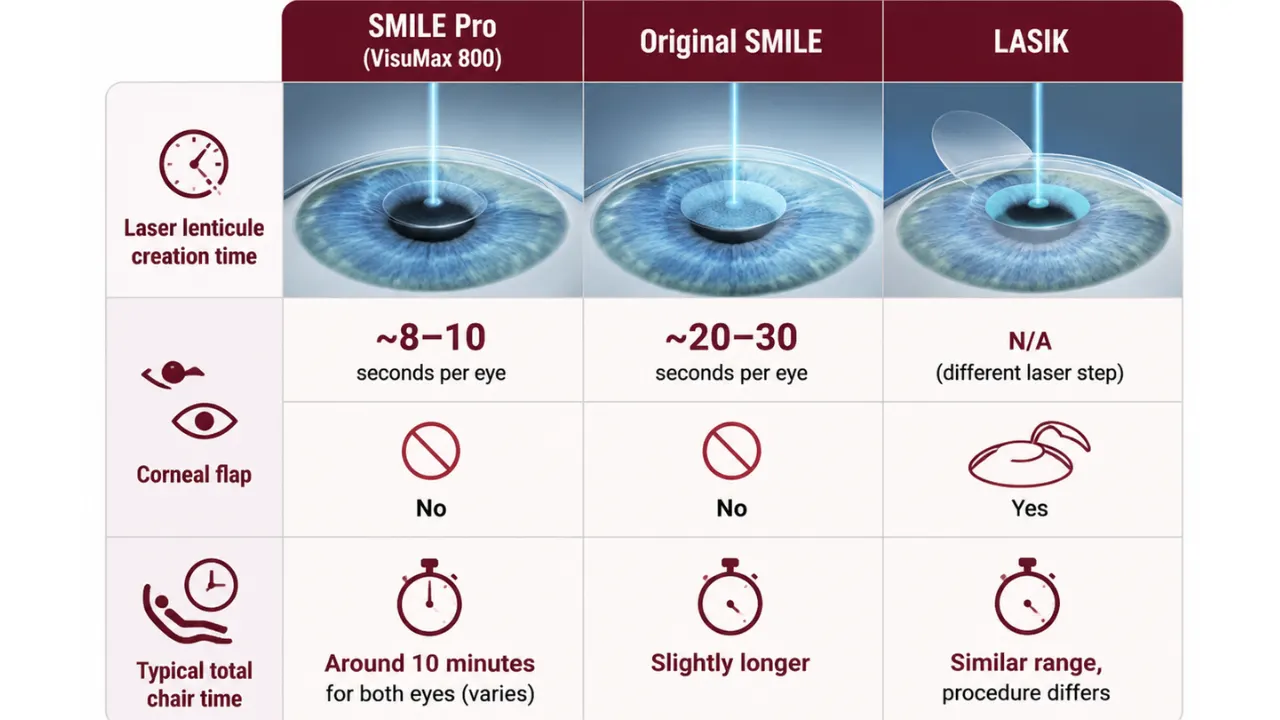
SMILE Pro (VisuMax 800) | Original SMILE | LASIK | |
Laser lenticule creation time | ~8–10 seconds per eye | ~20–30 seconds per eye | N/A (different laser step) |
Corneal flap | No | No | Yes |
Typical total chair time | Around 10 minutes for both eyes (varies) | Slightly longer | Similar range, procedure differs |
Faster laser time doesn't necessarily mean a "better" outcome by itself — it mainly means less time your eye needs to stay perfectly still, which can improve comfort and precision consistency.
Are You the Right Candidate for Smile pro?
Fill the form & we will tell you if LASIK is right for you. Its Free!
Is a Faster Procedure Safer?
- A shorter active laser time can reduce the chance of tiny eye movements affecting the treatment, since there's less time to stay still.
- However, safety and outcomes depend on many factors beyond speed — including your candidacy, corneal measurements, and the surgeon's experience.
- Research comparing outcomes between the newer and older SMILE laser platforms has generally shown comparable safety and visual results, with the newer platform mainly offering a faster, more comfortable patient experience rather than a fundamentally different outcome.
Benefits and Limitations
Benefits | Limitations |
Very short active laser time; less time needing to stay still | Still requires a proper recovery period, even though the procedure itself is quick |
No corneal flap to lift | Not suitable for every prescription or corneal profile — needs a full eligibility check |
Small incision, generally associated with lower short-term dry eye risk | Vision isn't perfectly clear immediately after; some blurring is expected initially |
When Should You Contact Your Clinic After Surgery?
Contact your surgical team promptly if you notice:
- Sudden, significant vision loss (beyond expected initial blurriness)
- Severe or worsening eye pain
- Increasing redness, discharge, or signs of infection
- Flashes of light or a sudden increase in floaters
These symptoms need timely medical review, even though they're uncommon after this type of procedure.
Knowing what happens minute by minute can make the day feel far less intimidating — most patients are surprised at how quick and manageable it feels compared to what they imagined. That said, "how it goes" for you specifically depends on your individual eye measurements and candidacy. A detailed pre-surgery consultation with a qualified refractive surgeon is the best way to know exactly what your procedure day will look like.
Frequently Asked Questions
Is SMILE Pro really done in 10 minutes?
The total time in the treatment chair for both eyes is often around 10 minutes, but the laser is only actively working for about 8–10 seconds per eye — the rest is positioning and careful preparation.
Does SMILE Pro hurt?
Numbing eye drops are used, so most patients don't feel sharp pain, though some pressure or mild discomfort during the suction step is common.
Am I awake during SMILE Pro surgery?
Yes, it's done under local anaesthetic eye drops while you remain awake and can follow your surgeon's guidance throughout.
How soon can I see clearly after SMILE Pro?
Vision is typically blurry immediately afterward and improves over the following hours to days; exact timing varies by individual healing.
Is SMILE Pro faster than the original SMILE procedure?
Yes. The newer VisuMax 800 laser platform used in SMILE Pro creates the lenticule roughly three times faster than the earlier SMILE laser generation.
Does a faster laser mean better results?
Not necessarily better results, but it can mean improved comfort since your eye needs to stay still for a shorter time; overall safety and outcome depend on multiple factors, not speed alone.
Can both eyes be done in the same sitting?
Often yes, done sequentially in the same visit, though your surgeon will confirm what's appropriate for your specific case.

Dry Eye After LASIK: Causes, Treatments & Long-Term Care
Dry eye after LASIK is a common and usually temporary side effect caused by temporary nerve disruption in the cornea, and it can be effectively managed with proper treatment and long-term eye care.

What Does 6/6 or 6/12 Vision Mean?
6/6 means normal vision. 6/12 means reduced clarity—you see at 6m what a person with normal sight sees at 12m.

Is Laser Eye Treatment Safe for Athletes?
Laser eye surgery is safe for most athletes—with the right procedure and timing. Find out what works best for your sport.