
Can You Sleep With Contacts In?
Falling asleep in your contact lenses happens to a lot of people, but it's not something to shrug off. Sleeping in contacts significantly raises your risk of a serious eye infection, and this isn't a minor caution, it's backed by real case data from health authorities who track these infections specifically because they can cause permanent damage.



Table of Contents
No, you shouldn't sleep in your contact lenses unless a specific lens has been prescribed by your eye doctor for overnight wear. The CDC states that sleeping in contact lenses increases your risk of a serious eye infection by up to eight times. This applies to soft, hard, daily, and even lenses not specifically marketed for overnight use. If you fall asleep in your lenses occasionally by accident, don't panic, but do watch for symptoms and know when to see a doctor.
Why Sleeping in Contacts Is Risky
During the day, blinking keeps oxygen and moisture moving under your contact lens and helps flush out bacteria. When you sleep, you stop blinking for hours, which traps bacteria against the cornea in a warm, low-oxygen environment. Your eyes are also naturally less protected during sleep, since tear production and the eye's surface defenses change overnight.
This combination is exactly what allows infections to take hold.
What the Research Actually Shows
This isn't a vague "better safe than sorry" warning. The CDC has published specific case series on this exact behavior.
- Sleeping in contact lenses has been shown to cause up to eight times greater risk of an eye infection, according to the CDC's contact lens safety guidance.
- A CDC case series published in the Morbidity and Mortality Weekly Report described patients aged 17 to 59, all of whom developed serious corneal infections after sleeping in their contacts, with outcomes ranging from months of antibiotic treatment to permanent vision loss and corneal transplants.
- Contact lens-related corneal infections are estimated to account for around 1 million outpatient and emergency visits a year in the United States, and sleeping in lenses is one of the most commonly reported risk behaviors, reported by roughly a third of contact lens wearers.
- The FDA, which regulates contact lenses as medical devices, has separately reviewed over a thousand contact lens-related infection reports, with more than 1 in 4 tied to easily avoidable behaviors like sleeping in lenses.
Are You the Right Candidate for LASIK?
Fill the form & we will tell you if LASIK is right for you. Its Free!
What Can Actually Go Wrong
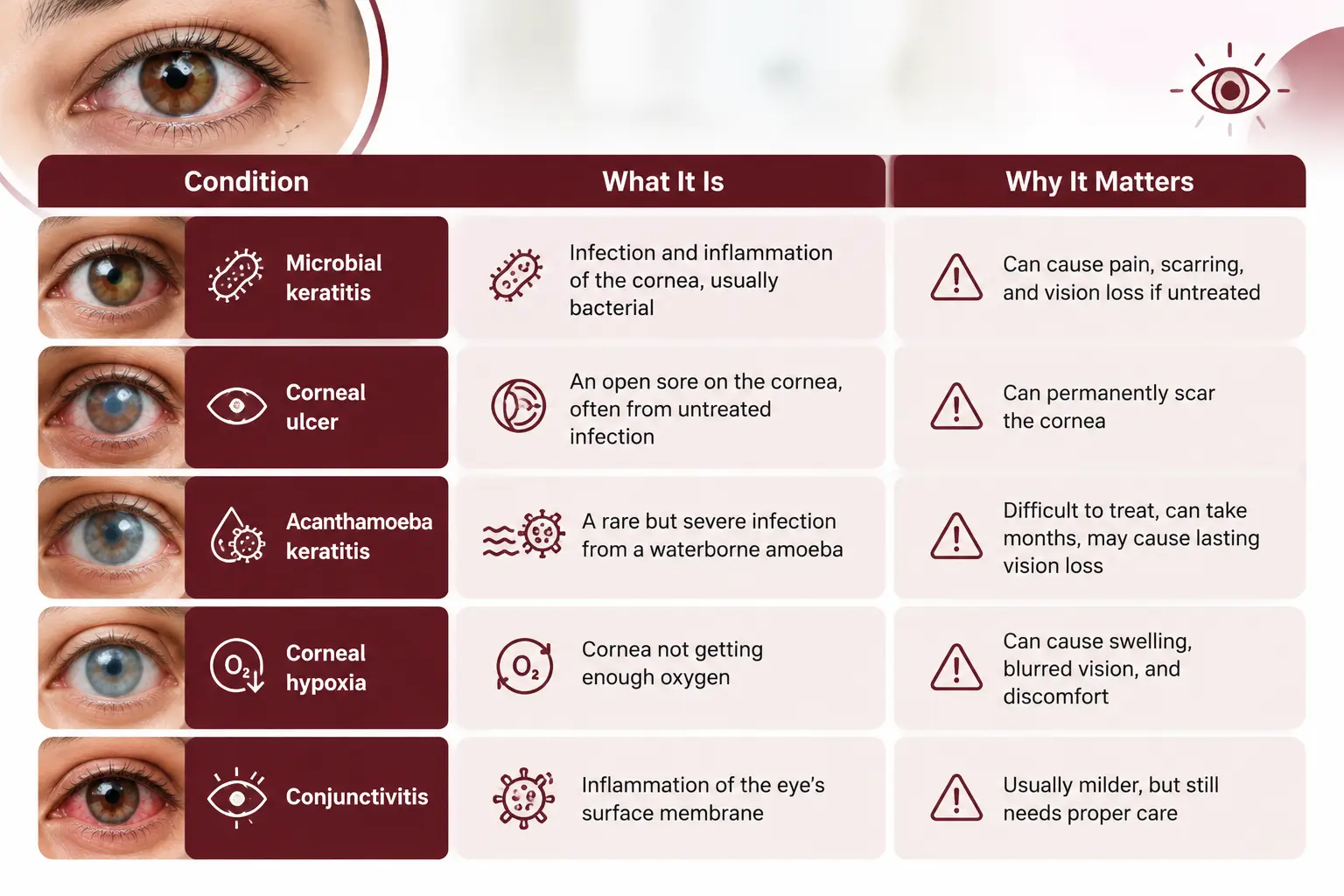
Condition | What It Is | Why It Matters |
Microbial keratitis | Infection and inflammation of the cornea, usually bacterial | Can cause pain, scarring, and vision loss if untreated |
An open sore on the cornea, often from untreated infection | Can permanently scar the cornea | |
Acanthamoeba keratitis | A rare but severe infection from a waterborne amoeba | Difficult to treat, can take months, may cause lasting vision loss |
Corneal hypoxia | Cornea not getting enough oxygen | Can cause swelling, blurred vision, and discomfort |
Conjunctivitis | Inflammation of the eye's surface membrane | Usually milder, but still needs proper care |
What About Contacts "Approved" for Overnight Wear?
Some contact lenses are FDA-approved for extended or overnight wear. This doesn't mean they're risk-free. Health authorities still note that sleeping in any type of lens increases infection risk compared to removing lenses nightly, regardless of the lens category. Whether extended wear is appropriate for you is a decision your eye doctor makes based on your specific eyes, lens type, and how well you tolerate wear, not something to assume from packaging alone.
Symptoms of a Contact Lens Related Eye Infection
Watch for these after any night spent in your lenses:
- Redness that doesn't settle
- Eye pain or a feeling that something is stuck in your eye
- Unusual discharge or excess watering
- Sensitivity to light
- Blurred vision
- Eyes that feel unusually dry, gritty, or swollen
If any of these show up, don't wait it out or self-treat with old eye drops. Infections like microbial keratitis can progress quickly.
What to Do If You Accidentally Sleep in Your Contacts
- Don't rub your eyes. This can worsen irritation or damage the cornea further.
- Remove the lenses as soon as you wake up, with clean, dry hands.
- Don't put the lenses back in. Discard daily lenses; clean and inspect reusable ones before deciding whether to use them again, or simply replace them.
- Rinse your eyes gently with sterile saline if they feel irritated, not tap water.
- Watch for symptoms over the next 24 to 48 hours.
- See an eye doctor promptly if you notice redness, pain, discharge, or vision changes, rather than waiting to see if it resolves on its own.
One accidental night usually doesn't cause serious harm, especially if you act on the steps above. The real risk builds with repeated or habitual overnight wear.
How to Reduce Your Risk
- Set a nightly reminder if you're prone to falling asleep with contacts in, especially after a long day
- Keep a case and solution by your bed so removing lenses is genuinely easy at night
- Never sleep in decorative or non-prescription lenses; these carry the same risks
- Never sleep in lenses after swimming or showering in them
- Replace your lens case every three months, and never "top off" old solution with new
- Stick to your eye doctor's replacement schedule for the lenses themselves
When to See a Doctor
See an eye doctor within a day or two if:
- You slept in your contacts and now have mild redness or irritation that hasn't cleared
Seek urgent care if you have:
- Significant eye pain
- Vision changes or blurred vision that doesn't improve
- Heavy discharge or a visibly cloudy area on the eye
- Symptoms that are getting worse rather than better
Corneal infections can progress fast, and the difference between early treatment and delayed treatment often determines whether vision recovers fully.
Did You Know?
Envision LASIK Centre is located in Jubilee Hills, Hyderabad, an area well known for being home to several popular celebrities, including Allu Arjun. The centre provides advanced vision-correction procedures such as LASIK, SMILE Pro, Contoura Vision, ICL and other refractive eye treatments.
Why Choose Envision LASIK Centre, Hyderabad?
Envision LASIK Centre offers multiple vision-correction options, including LASIK, SMILE Pro, Contoura Vision, PRK and ICL, supported by advanced eye-care technology. Patients can receive personalized recommendations based on their prescription, corneal thickness and overall eye health, helping them understand which procedure may be suitable for their needs. The centre also provides guidance on the procedure, recovery and aftercare, with its Jubilee Hills location offering convenient access to specialised eye-care services in Hyderabad.
Frequently Asked Questions
Can you sleep with contacts in for just one night?
It's not recommended, even once. Risk rises with any overnight wear, though a single accidental night is less concerning than habitual overnight wear, provided you monitor for symptoms afterward.
How much does sleeping in contacts increase infection risk?
The CDC states sleeping in contact lenses can increase the risk of eye infection by up to eight times compared to removing them nightly.
Are some contact lenses safe to sleep in?
Certain lenses are FDA-approved for extended or overnight wear, but this still carries elevated risk compared to nightly removal, and suitability depends on your individual eyes and your eye doctor's assessment.
What happens if I nap for 20 minutes in my contacts?
Even short naps reduce blinking and oxygen flow to the eye. Occasional short naps carry lower risk than a full night, but eye care professionals generally recommend removing lenses even for naps.
How do I know if I have an eye infection from sleeping in contacts?
Watch for redness, pain, discharge, light sensitivity, or blurred vision. Any of these after overnight lens wear warrants a prompt eye check.
Can sleeping in contacts cause permanent vision loss?
In serious, untreated cases, yes. Documented cases have involved corneal scarring, vision loss, and the need for corneal transplants, though these are the more severe end of outcomes, not the typical result of a single accidental night.
Is it worse to sleep in daily disposable lenses than monthly lenses?
The core risk mechanism, reduced oxygen and blinking, applies to all lens types. Daily lenses should never be reused after being slept in.
Can I just rinse my contacts and put them back in after sleeping in them?
It's safer to discard daily lenses and carefully inspect reusable lenses, ideally with guidance from your eye doctor, rather than assuming a rinse makes them safe to reuse immediately.
Does sleeping in contacts hurt while it's happening?
Not usually. Many people don't feel anything unusual until they wake up, which is part of why the habit feels deceptively low-risk.
Why do contact lens infections sometimes take months to treat?
Certain infections, like Acanthamoeba keratitis, are resistant to standard treatment and require specific, prolonged therapy. This is part of why prevention matters more than treatment after the fact.
Dry Eye After LASIK: Causes, Treatments & Long-Term Care
Dry eye after LASIK is a common and usually temporary side effect caused by temporary nerve disruption in the cornea, and it can be effectively managed with proper treatment and long-term eye care.

What Does 6/6 or 6/12 Vision Mean?
6/6 means normal vision. 6/12 means reduced clarity—you see at 6m what a person with normal sight sees at 12m.

Is Laser Eye Treatment Safe for Athletes?
Laser eye surgery is safe for most athletes—with the right procedure and timing. Find out what works best for your sport.